
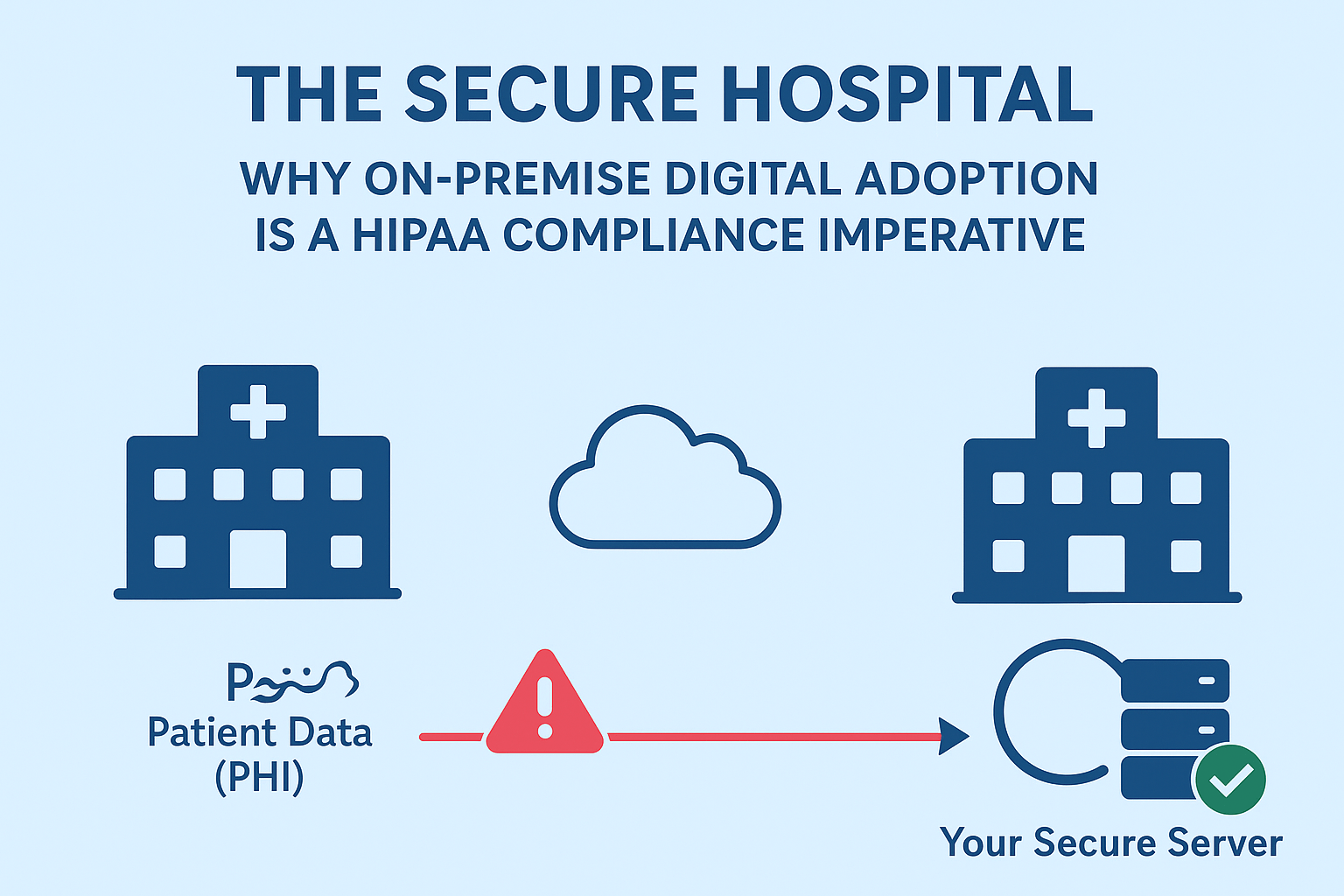
The Secure Hospital
As a hospital CIO or CISO, you live with a constant, low-level hum of anxiety about data security. A single breach of Protected Health Information (PHI) can trigger multi-million dollar fines, catastrophic reputational damage, and a fundamental loss of patient trust.
You’ve invested heavily in securing your core systems – your EHR, your firewalls, your data centers. But a new, often overlooked, threat vector is emerging: the very tools meant to improve your clinician’s experience.
Cloud-based Digital Adoption Platforms (DAPs) promise to simplify EHR workflows, but they do so by processing user interactions and on-screen data on third-party servers. This means your sensitive PHI is leaving your secure environment. Even with a Business Associate Agreement (BAA) in place, you’ve introduced a new link in the security chain that you don’t control.
In the high-stakes world of healthcare, that is an unacceptable risk.
The Illusion of Cloud Security for PHI
Cloud software vendors often tout their “HIPAA-compliant” status. However, this typically means they have the necessary controls in place for their own infrastructure. It does not change a fundamental fact: to guide a user, a cloud DAP must “see” what is on their screen.
This creates several critical risks:
- Data in Transit: PHI is transmitted from your endpoints to the vendor’s cloud, creating a potential point of interception.
- Data at Rest (in the Cloud): Your patient data is now stored on someone else’s servers, making you dependent on their security protocols and personnel.
- Increased Attack Surface: You have expanded your hospital’s digital footprint, creating more potential targets for malicious actors.
- Loss of Data Sovereignty: You no longer have full, direct control over where your patient data resides or who has access to it.
A BAA is a legal contract, not a technical control. It outlines liability after a breach has already occurred. True HIPAA compliance requires a security-first architecture that prevents the breach from happening in the first place.
The On-Premise Imperative: The Only True Solution for Healthcare
The only way to gain the powerful benefits of digital adoption without compromising security is to keep your data within your own walls. This is the on-premise imperative.
An on-premise Digital Adoption Platform, like Anakage, is deployed entirely within your own secure infrastructure. It is a core part of our “Offline & On-Premise Superpower”, a strategic design choice made specifically for security-sensitive industries like healthcare.
Here’s what that means in practice:
- Zero Data Transmission: No PHI ever leaves your network. All user guidance, workflow automation, and analytics processing happen on your servers.
- Complete Control: Your IT and security teams retain full control over the application, the data, and all access policies.
- Air-Gapped Potential: The platform can operate in completely air-gapped environments, ensuring the highest level of security.
- Reduced Vendor Risk: You are not reliant on a third-party’s security posture to protect your most critical asset.
This isn’t just a feature; it’s a fundamentally different and superior security architecture. While our competitors focus on cloud-native SaaS, we have engineered our platform to solve the fundamental constraints of regulated industries, creating a defensible advantage for our clients.
Proof Point: Achieving 99% Compliance in a Highly Regulated Environment
The need for stringent, on-premise security is not unique to healthcare. The financial sector faces similar regulatory pressures. For a leading Indian private bank, we deployed our automation platform to address their compliance challenges.
Operating under strict policies that prohibited common but risky tools like PowerShell, the bank struggled to maintain 100% endpoint compliance. By using Anakage’s secure, on-premise automation, the bank achieved 99% compliance and reduced manual IT effort by 85%. This demonstrates our ability to deliver powerful results within the tightest security and regulatory frameworks.
Don’t Trade Usability for Security – Demand Both
As we detailed in our article A CIO’s Guide to Solving EHR Burnout & Driving Clinical Adoption, improving the usability of your clinical systems is critical. But that improvement cannot come at the cost of security.
You don’t have to make that trade-off. By choosing an on-premise digital adoption strategy, you can provide your clinicians with the in-app support they need to be effective while upholding your most important promise to your patients: the absolute security of their data.
Is your digital adoption strategy truly HIPAA compliant?
Schedule a 15-minute demo to see how Anakage’s on-premise platform keeps your patient data safe.
Have you read about our last release? Click here to read!
Frequently Asked Questions (FAQ)
- Q: What is the main HIPAA compliance risk of cloud-based Digital Adoption Platforms (DAPs)?
A: Cloud DAPs must “see” and process on-screen data, including Protected Health Information (PHI), on third-party servers. This transmits sensitive patient data outside the hospital’s secure network, creating risks of interception, data breaches, and a loss of data sovereignty. - Q: What is an on-premise DAP?
A: An on-premise DAP is a digital adoption platform that is deployed entirely within a hospital’s own secure infrastructure. No patient data or PHI ever leaves the network, ensuring complete control and security. - Q: Does a Business Associate Agreement (BAA) make a cloud DAP fully secure for PHI?
A: No. A BAA is a legal contract that outlines liability after a breach has already occurred. It is not a technical security control and does not prevent the PHI from leaving your secure environment and being stored on third-party servers. - Q: Why is an on-premise DAP a “HIPAA imperative” for healthcare?
A: Because it is the only architecture that allows hospitals to gain the benefits of in-app guidance and workflow automation (like reducing EHR burnout) without compromising the security and control of Protected Health Information (PHI).