Training Nurses in the Flow of Work
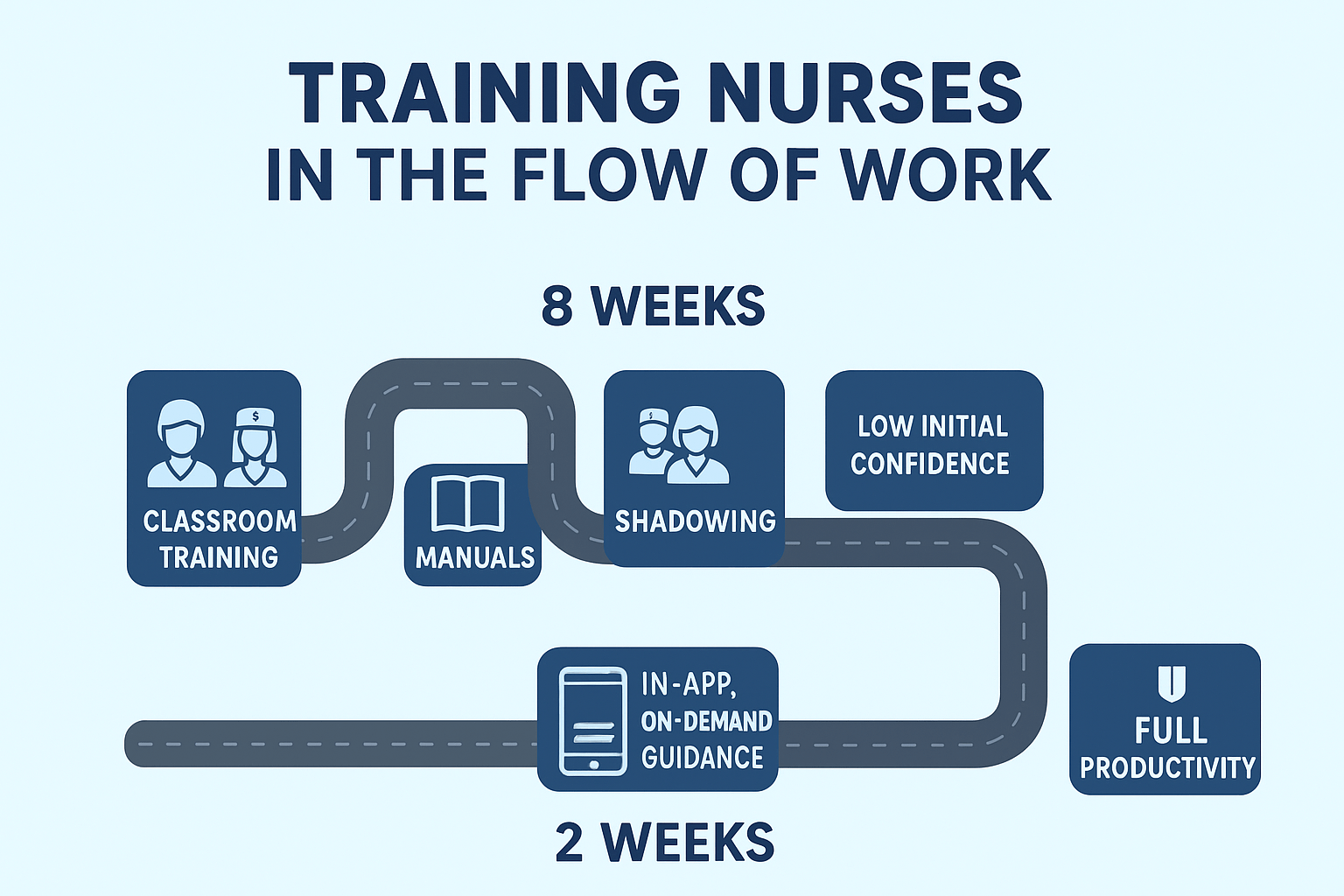
Your hospital runs on the skill and dedication of its nursing staff. But in an industry where nurse turnover is a persistent and costly reality, you’re trapped in a perpetual cycle of onboarding. New nurses spend weeks in classrooms and shadowing preceptors, slowly learning the intricacies of your EHR and clinical workflows.
This traditional training model is slow, expensive, and disconnected from the reality of patient care. It pulls your experienced nurses away from the bedside to act as trainers and leaves new hires feeling overwhelmed when they finally start their shifts.
What if you could break this cycle? What if you could slash your nurse onboarding time by 75%, taking a standard two-month orientation and condensing it into just two highly effective weeks?
The Hidden Costs of Classroom-Based Training
The direct cost of replacing a nurse is significant, but the indirect costs of a slow onboarding process are just as damaging.
- Preceptor Burnout: Your most experienced nurses are burdened with repetitive training tasks, pulling them away from complex patient care and contributing to their own burnout.
- Delayed Competency: New nurses take longer to become fully productive and confident, which can impact patient ratios and team morale.
- Inconsistent Knowledge: Classroom learning doesn’t guarantee real-world application. Nurses often develop inconsistent workarounds when faced with a live, high-pressure situation they don’t remember from a manual.
- High Error Rates: New employees are naturally more prone to making mistakes. When they lack immediate support within their workflow, the risk of data entry errors in the EHR increases.
This model simply isn’t built for the dynamic, high-stakes environment of a modern hospital.
The Solution: Learning in the Flow of Work
Instead of pulling nurses away from the floor for training, a Digital Adoption Platform (DAP) brings the training directly to them, inside the EHR, at the exact moment they need it.
This is “learning in the flow of work.” It transforms a static training process into a dynamic support system.
- On-Demand Walkthroughs: A new nurse charting a complex admission? A simple on-screen guide walks them through every required field, step-by-step.
- Contextual Help: Unsure which order set to use? A pop-up provides instant, role-based suggestions, eliminating guesswork.
- Real-Time Validation: The system validates data as it’s entered, preventing errors before they are saved and ensuring process compliance from day one.
This approach turns the EHR from a source of frustration into a self-teaching tool. The impact of this model is transformative. For a leading German manufacturer facing similar challenges with complex software, implementing this exact type of live, in-app guidance reduced their employee onboarding time from 2 months to just 2 weeks.
Imagine the impact on your hospital if every new nurse could confidently and competently use your systems in a fraction of the time.
Beyond Onboarding: Supporting Your Entire Workforce
This isn’t just about new hires. An in-app guidance strategy supports your entire team.
- Rolling out New Procedures: When a clinical protocol changes, you can push interactive notifications and guides to every relevant nurse instantly, ensuring 100% adoption of the new standard.
- Supporting a Diverse Staff: For hospitals with a multilingual workforce, you can deliver content and on-screen guidance in each user’s preferred language, improving comprehension and reducing errors. One organization saw a 70% success rate in resolving end-user issues by implementing this multilingual, self-service support.
By focusing on the broader goal of improving the Digital Employee Experience, you create a more resilient and capable workforce.
Give Your Nurses the Support They Need, Where They Need It
Your nurses are your hospital’s most valuable asset. Providing them with intuitive, real-time support is one of the most powerful investments you can make in their success and retention. By moving training out of the classroom and into the workflow, you can reduce costs, improve efficiency, and empower your nurses to focus on what they do best: providing exceptional patient care.
Ready to cut your nurse onboarding time by 75%?
Schedule a 15-minute demo to see how Anakage can deliver on-demand training directly within your EHR.
Have you read about our last release? Click here to read!
Frequently Asked Questions (FAQ)
- Q: Why is traditional nurse onboarding inefficient?
A: Traditional classroom training is disconnected from the real-world pressures of patient care. Knowledge is quickly forgotten, it pulls experienced preceptors away from the bedside (causing burnout), and it leads to inconsistent workflows and higher error rates in the EHR. - Q: What is ‘learning in the flow of work’ for nurses?
A: It means providing training and support directly within the EHR system at the exact moment a nurse needs it. A Digital Adoption Platform (DAP) does this with on-screen walkthroughs and contextual help, eliminating the need for classroom sessions. - Q: How does a Digital Adoption Platform (DAP) reduce onboarding time?
A: A DAP provides real-time, step-by-step guidance for complex EHR tasks. This allows new nurses to become competent and productive faster (e.g., in two weeks instead of two months) by learning as they work, which also reduces errors and preceptor burnout. - Q: Can a DAP help with more than just new nurse onboarding?
A: Yes. A DAP can be used to instantly roll out new procedures or protocol changes to all staff. It can also provide multilingual support for a diverse workforce, ensuring everyone understands and follows correct processes.