
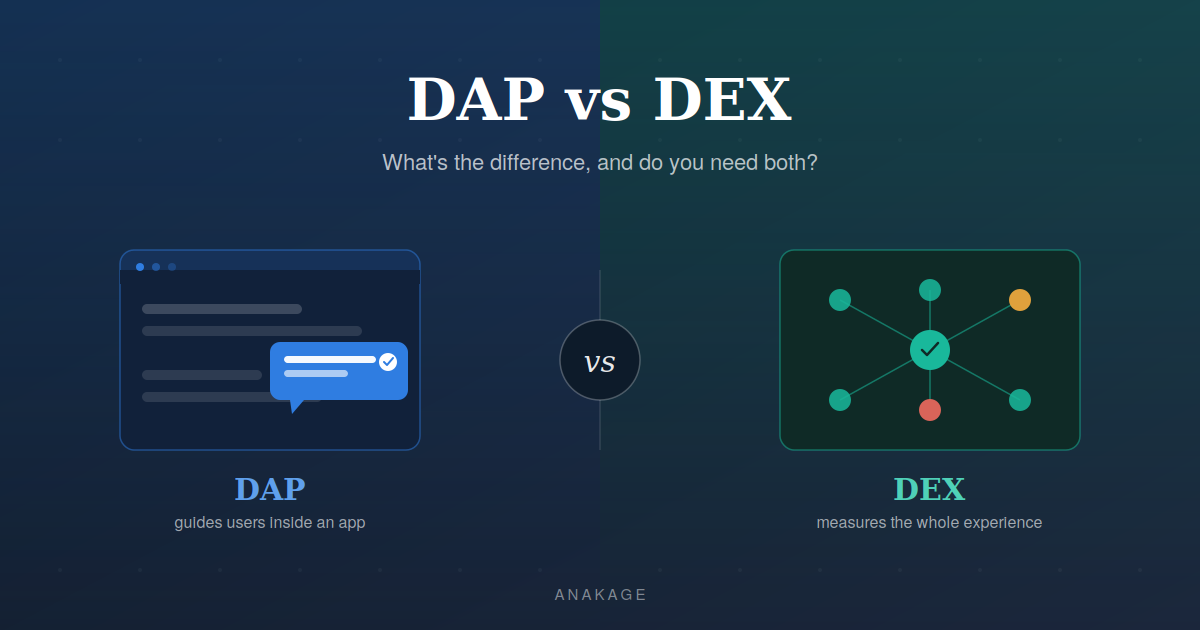
A DAP guides users inside an application. A DEX tool measures and fixes the experience across their whole device and software environment. They solve different problems, and many teams need both working together.
The confusion is common. Vendors now bundle the two, so the line between them blurs. This guide separates them clearly and helps you decide what your team actually needs.
Contents
What Is a DAP?
DAP stands for Digital Adoption Platform. It is a software layer that sits on top of an application and guides users through tasks.
Think of in-app tooltips, step-by-step walkthroughs, and self-help menus. The user gets help exactly when they are stuck, inside the screen they are using.
A DAP answers one question: are people using this software correctly? It drives adoption and cuts down training time.
A DAP helps most when:
- New employees are learning a complex ERP or CRM
- You are rolling out new features and want to skip long manuals
- Repeat support tickets come from the same few confusing screens
What Is a DEX?
DEX stands for Digital Employee Experience. A DEX tool measures the quality of an employee’s entire digital workday.
It tracks device performance, application crashes, network issues, and how users feel about their tools. DEX looks at the full picture, not one application.
DEX answers a different question: is technology helping or frustrating our people? It finds friction and, in advanced setups, fixes it automatically.
A DEX helps most when:
- You manage thousands of endpoints across many sites
- Slow laptops and failing apps cause silent productivity loss
- You want to spot faults before users raise complaints
Gartner notes that the gap between digital adoption and DEX is closing fast. Modern strategies increasingly treat them as connected, not separate.
DAP vs DEX: The Core Difference
The simplest way to remember it is scope:
- DAP works inside one application and guides the user
- DEX works across the device and environment and monitors the experience
One drives correct usage. The other measures and improves overall health. A DAP is about guidance. A DEX is about visibility and remediation.
A Quick Scenario
An employee cannot complete an expense claim. A DAP shows them the right steps inside the app.
But if the app keeps crashing because their laptop is low on memory, that is a DEX problem. The DAP cannot fix the root cause. This is why the two complement each other.
Do You Need Both?
For most mid-to-large enterprises, the honest answer is yes, but rarely at the same time.
Start with your biggest pain:
- If users struggle to use software correctly, a DAP delivers faster wins
- If devices and apps keep failing, a DEX tool matters more first
In our experience working with Indian enterprises, teams often begin with one and add the other as they mature. You do not have to buy everything on day one.
Watch the Cost
Enterprise tools like WalkMe and Nexthink are powerful but expensive. Many teams on Reddit report heavy setup effort and high per-device pricing.
This is where it pays to look at your real needs. Some vendors now combine DAP and DEX features in one platform, which can lower total cost.
Anakage is one option worth considering here. It blends self-help guidance with self-healing automation in a single tool, and supports on-premise deployment for offline or compliance-heavy networks. It is built for that specific use case, not for everyone.
How to Choose for Your Environment
Match the tool to your environment, not the hype. A few quick rules:
- Cloud-first companies have wide choice and can favour lighter SaaS tools
- Banks, NBFCs, and government bodies often need on-premise tools that work without internet
- Air-gapped or compliance-driven setups narrow the field sharply
Teams preparing for an RBI audit, for example, need local control and audit-ready reporting. Anakage fits these on-premise, regulated scenarios, though cloud-first teams may prefer something lighter.
FAQ
Q: What is the difference between DAP and DEX?
A: A DAP guides users inside a specific application with prompts and walkthroughs. A DEX tool measures and improves the employee’s entire digital experience across devices and apps. One drives usage; the other monitors overall health.
Q: Is a DAP the same as a DEX tool?
A: No. They overlap but solve different problems. A DAP focuses on adoption within software. A DEX focuses on visibility and remediation across the whole environment.
Q: Do I need both a DAP and a DEX platform?
A: Many enterprises eventually use both. Start with your bigger pain point. Add the second tool as your maturity and budget grow.
Q: Which comes first, DAP or DEX?
A: It depends on your problem. Choose a DAP first if users struggle to use software. Choose DEX first if devices and apps fail often.
Q: Are DAP tools worth the cost?
A: They are when adoption and training costs are high. For smaller teams or simple apps, premium tools like WalkMe can be overkill. Match the spend to the problem.
Q: Can one tool do both DAP and DEX?
A: Some platforms now combine guidance, monitoring, and automation. This can reduce cost and complexity, especially for teams that want a single vendor.
Q: What is the best DAP for enterprises in India?
A: There is no single best. For offline networks and compliance needs, on-premise tools matter most. Cloud-first firms have wider SaaS options to choose from.
Choose based on your real bottleneck, not vendor labels. A DAP fixes how people use software, while a DEX tool fixes the experience around it.
If your environment is offline or compliance-heavy, Anakage offers a free 30-minute demo at anakage.com/book-a-demo worth checking if that matches your setup.