
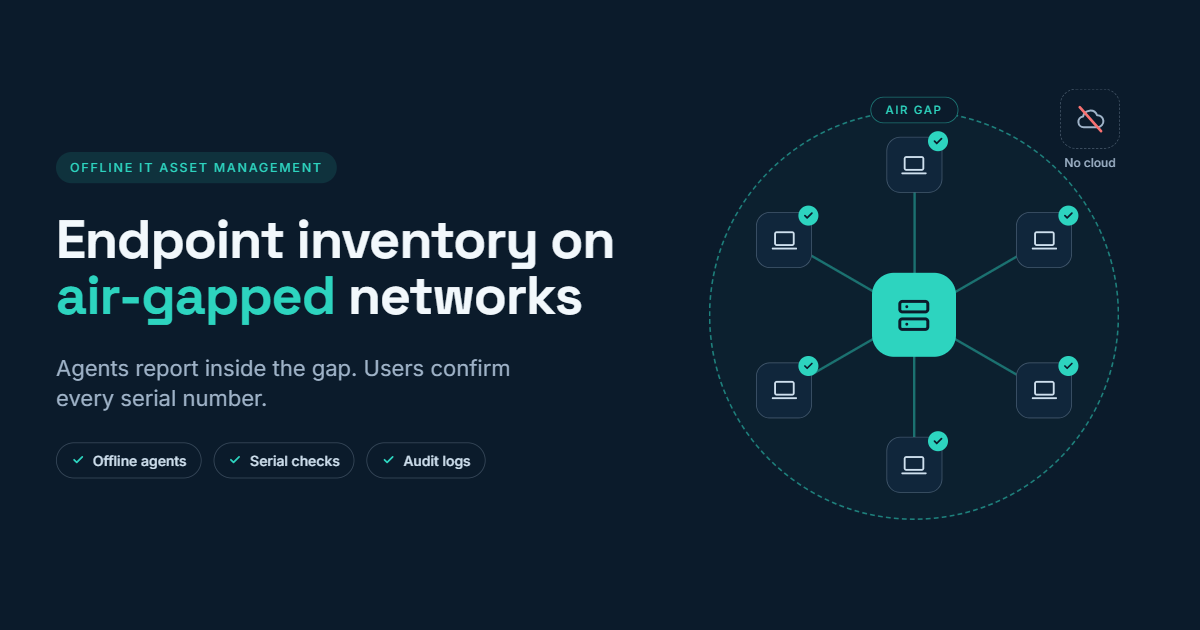
Anakage builds an endpoint inventory on an air-gapped network with a lightweight agent and an on-premise server. Each agent reports hardware and software details inside your network, with no cloud connection. Users then confirm serial numbers through a short campaign, so your register matches the physical machines.
That covers most audit questions on managed devices. It does not cover everything, and this post says where the limits sit.
Endpoint — any laptop, desktop, or server that connects to your network.
Air-gapped network — a network that is physically isolated from the internet and all external connections.
How Does Anakage Build an Endpoint Inventory on an Air-Gapped Network?
Anakage supports cloud, on-premise, hybrid, disconnected, and fully air-gapped environments with no cloud dependency required. On an isolated network, that means the server and agents run entirely inside your walls. anakage
Here is what the inventory captures:
- Hardware and health. The agent monitors hardware health in real time, covering battery, CPU, and disk. anakage
- Software. Discovery records version, publisher, and install base, with version histories. anakage
- Assets without agents. Bulk upload covers routers and other gear that cannot run an agent. anakage
- Location and ownership. Role-based views let you filter assets by location or department. anakage
- Directory links. Directory service integrations (AD, HRMS) keep records current when a user changes departments. anakage
Cloud tools cannot do this work offline. Freshservice, AssetTiger, and NinjaOne cannot manage air-gapped endpoints at all. anakage
How Does Anakage Run Physical Asset Verification Offline?
Physical asset verification (PAV) — a periodic check that every asset in your register exists and sits where the register says.
Anakage offers two ways to run PAV. Both work from your own server.
In the agentless method, IT sends a link from an on-premise server. Users download a lightweight collector, enter the physical serial number, and finish in under a minute. In the proactive method, the agent pops up on screen with machine details and asks the user to confirm the serial number. Users get a limited number of snoozes. anakageanakage
Here is how a campaign runs:
- The agent or collector gathers device details.
- An admin launches a campaign to chosen users or locations.
- Each user sees a pre-filled record and confirms the serial number or flags a mismatch.
- Unanswered campaigns go back to the admin for follow-up.
- Admins review confirmed records and flagged mismatches.
Pre-filling serial number, hardware specs, and last usage reduces user fatigue and improves response quality. For servers and routers, location tagging and role-based access let site admins verify non-user assets. anakageanakage
What Results Have Customers Seen?
A global IT service provider spent about 15 minutes per asset verification, over 50 hours of manual effort a month. Users self-declared some details while the tool collected the rest. Verification time fell by 50%. The same deployment cut overall incidents and service requests by 30%. Automating IT support incidents and mannual asset verification by 30% +2
Another enterprise ran PAV on ServiceNow. Each campaign took 6 to 8 months, and accuracy stayed near 90%. Anakage built a multi-level verification flow integrated with ServiceNow, with updates pushed back in real time. anakageanakage
How Does This Help With RBI and ISO 27001 Audits?
Banks, NBFCs, and their vendors must keep IT asset and software license records for RBI IT audits. Tools should produce date-stamped, exportable reports. anakageanakage
ISO 27001:2022 expects the same discipline. Annex A control 5.9 requires an inventory of information and other associated assets.
Anakage keeps an audit trail of monitoring activities, changes, and remediation efforts. On-premise deployment also keeps asset data inside your network, which supports DPDP obligations. anakage
Keep this evidence ready for auditors:
- A dated export of the full inventory
- PAV completion rate, with a list of exceptions
- The transfer log for agent installers
- A list of unmanaged assets, each with an owner
What Does Anakage Not Do for Asset Inventory?
Anakage is agent-first. It does not scan your network for unmanaged devices, and it does not discover virtual machines. Pair it with a scanner or bulk import for printers, switches, and similar gear.
It also suits some teams better than others. It is a poor fit for small businesses, cloud-first companies, and teams that need a free tool.
How Does Anakage Compare With Other Offline Inventory Options?
| Option | Approach | Pick it when |
|---|---|---|
| Anakage | Offline agents, user-driven verification, audit logs | Verification, offline fixes, and audit evidence matter most |
| ManageEngine AssetExplorer | On-premise ITAM; runs on disconnected networks | You want conventional on-premise asset management |
| Lansweeper | Agentless network scanning | Discovering unmanaged devices matters most |
| OCS Inventory or GLPI | Open-source, self-hosted | You have a small estate and staff to maintain the tool anakage |
These tools solve different problems. Many teams will combine two of them.
How Do You Roll Out Anakage on an Air-Gapped Network?
- Define your fields. Serial number, model, OS, owner, location, and installed software cover most audits.
- Install the server inside the gap. Keep it free of outbound internet calls.
- Carry the agent across. Scan removable media on a dedicated station first, then log every transfer. anakage
- Deploy the agent. Install it with the MSI installer, or push it through SCCM or a similar tool. anakage
- Import assets without agents. Use bulk upload with location and owner.
- Run a pilot campaign. Anakage’s branch guidance starts with 10 sites, then expands in waves of 25 to 50. anakage
- Repeat each year. Enterprises typically run physical asset audits every financial year. anakage
FAQ
Does Anakage work on an air-gapped network?
Yes. Anakage supports disconnected and fully air-gapped environments, with the server and agents running inside your network. No cloud connection is required.
Does Anakage scan the network for unmanaged devices?
No. It relies on agents for discovery. For printers, switches, and other devices without agents, use bulk upload or pair it with a network scanner.
How does Anakage verify physical assets?
It runs campaigns where users confirm pre-filled device details and the physical serial number. A user can finish in under a minute. Admins review confirmations and flagged mismatches.
Can Anakage integrate with ServiceNow or Active Directory?
Yes, on both. One customer ran multi-level PAV integrated with ServiceNow, with updates pushed back in real time. Directory integrations with AD and HRMS keep records current when users change departments.
How long does a verification campaign take?
Each user needs about a minute. The full campaign depends on how fast users respond, so plan one to two weeks. Manual cycles at one enterprise took 6 to 8 months.
What evidence does Anakage give for an RBI audit?
It keeps an audit trail of monitoring, changes, and remediation. You can export dated inventory and verification records. Pair them with your installer transfer log.
Is Anakage suitable for small businesses?
Usually not. It targets compliance-heavy and offline enterprise environments. Small teams or teams that need a free tool should consider open-source options.
An air-gapped inventory stays accurate when agents report inside the gap and users verify what they find. Add bulk import for devices without agents, and keep a dated log for auditors.
Anakage offers a free 30 minute demo for IT teams managing offline networks. Worth a look if that matches your setup: anakage.com/book-a-demo