
Contents
- 1 Why Manual Incident and Complaint Investigations Fail in Regulated Enterprises
- 1.1 The Hidden Fragility of Manual Investigations
- 1.2 Why This Problem Is Amplified in Regulated Industries
- 1.3 The Real Failure Point Is Not Speed. It Is Structure.
- 1.4 Why Traditional Tools Do Not Solve This
- 1.5 What Consistent Investigations Actually Require
- 1.6 Where Anakage Fits In
- 1.7 Manual Investigations Create Invisible Risk
- 1.8 The Shift That Matters
- 1.9 Where to Go Next
- 1.10 Frequently Asked Questions
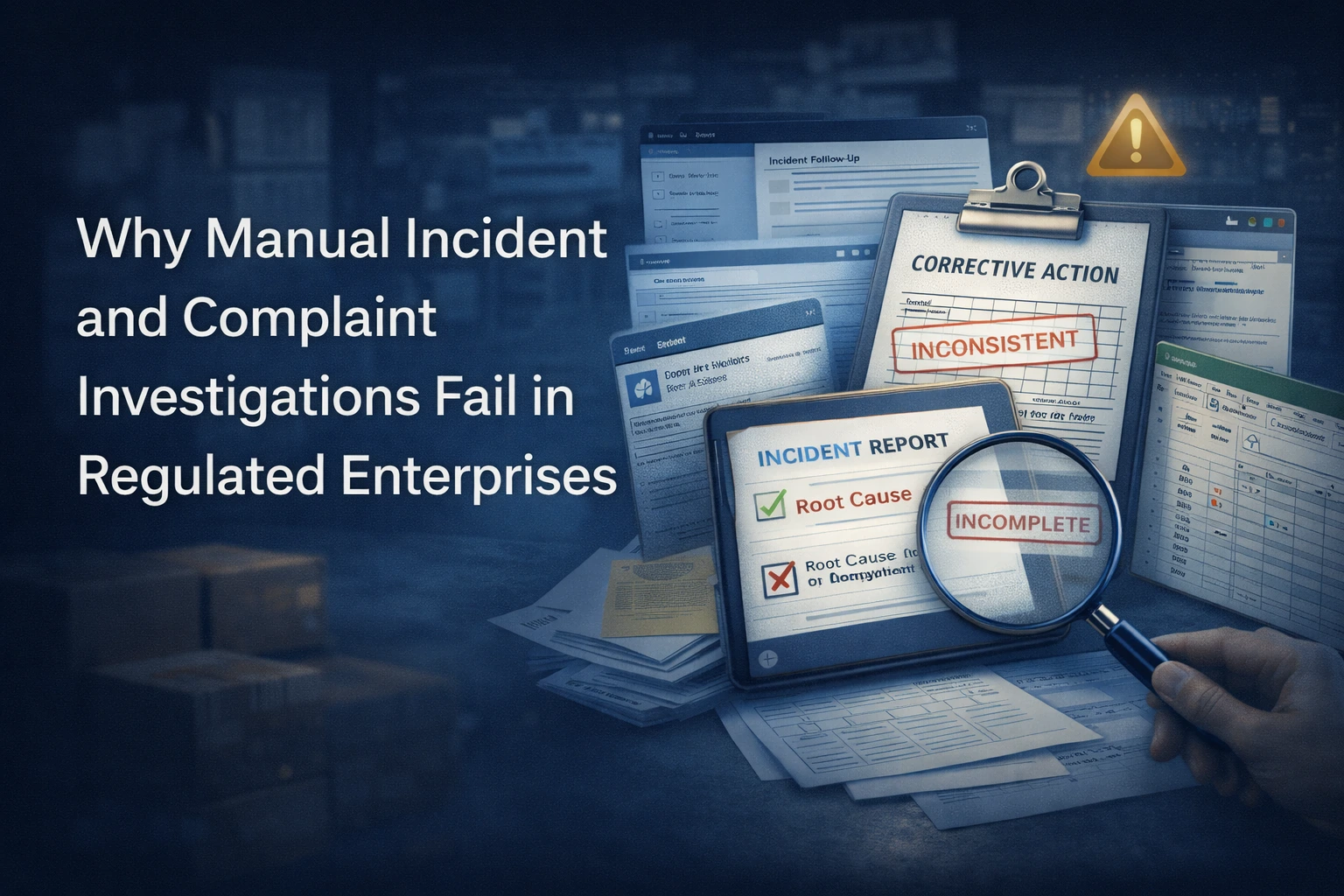
Why Manual Incident and Complaint Investigations Fail in Regulated Enterprises
In regulated enterprises, incidents and complaints are not just operational issues. They are moments of risk.
A delayed investigation can trigger regulatory scrutiny.
An incomplete root cause analysis can fail an audit.
An inconsistent corrective action can cause the same issue to repeat.
And yet, across industries like manufacturing, BFSI, pharma, energy, and government, incident and complaint investigations are still handled manually.
Emails.
Excel sheets.
Word documents.
Human judgment stitched together under pressure.
This approach feels familiar. It also fails far more often than organizations realize.
The Hidden Fragility of Manual Investigations
Most investigation failures do not happen because teams are careless or unskilled.
They happen because manual processes depend too heavily on individual behavior.
When investigations rely on people instead of systems, a few things inevitably occur:
- Different employees document the same issue in different ways
- Critical steps are skipped when teams are under time pressur
- Root cause analysis quality varies with experience, not standards
- Evidence is scattered across inboxes and folders
- Decisions are hard to defend months later during audits
The result is not just inefficiency. It is structural inconsistency.
In regulated environments, inconsistency is risk.
Why This Problem Is Amplified in Regulated Industries
Regulated enterprises operate under three constant constraints:
- You must follow defined processes
- You must prove that you followed them
- You must do it repeatedly, at scale
Manual investigations struggle with all three.
Manufacturing and Quality
A customer complaint or non conformance requires structured RCA, CAPA, and documentation aligned to ISO or IATF standards. When this is done manually, outcomes depend on who is filling the form, not what the standard requires.
BFSI and Insurance
Regulatory complaints and internal incidents demand traceability. Auditors do not ask what decision was taken. They ask how and why it was taken. Manual records rarely answer that convincingly.
Pharma and Life Sciences
Deviation management and GMP investigations require precision. Missing data, inconsistent narratives, or unverified actions can invalidate entire reports during audits.
Energy, Utilities, and Public Sector
Safety incidents, near miss reporting, and citizen grievances all require defensible investigations. Informal documentation exposes organizations to legal and reputational damage.
Across these industries, the challenge is the same. Human led investigations do not scale safely.
The Real Failure Point Is Not Speed. It Is Structure.
Most enterprises try to fix investigation problems by pushing for faster closure.
Faster is useful. But faster without structure only accelerates mistakes.
What regulated organizations actually need is:
- Mandatory data capture, not optional descriptions
- Guided root cause analysis, not free text explanations
- Defined containment and corrective steps, not informal fixes
- Standardized outputs, not custom documents every time
- A complete audit trail from initiation to closure
Manual methods cannot enforce this consistently.
That is why even well run organizations see repeated findings during audits.
Why Traditional Tools Do Not Solve This
Many teams attempt to fix investigation issues using tools that were never designed for this purpose.
- Email and spreadsheets offer flexibility but no enforcement
- Standalone forms capture data but do not guide reasoning
- Generic workflow tools move tasks forward but do not improve investigation quality
- Basic chatbots answer questions but do not control how decisions are made
None of these ensure that investigations are done the same way, every time.
Read ITSM Dashboards vs Excel Reports to understand why dashboards matter more than spreadsheets for investigations
What Consistent Investigations Actually Require
To eliminate investigation failures, enterprises must shift from documentation to process enforcement.
Effective incident and complaint investigations require systems that:
- Guide users step by step through predefined investigation logic
- Enforce RCA frameworks like 5 Whys or 5M consistently
- Prevent closure until mandatory steps are completed
- Capture evidence and actions in real time
- Generate audit ready reports automatically
- Create traceability across systems of record like ITSM
Read Guide to ITSM to understand why integrating investigations with ITSM systems of record is important.
Where Anakage Fits In
Anakage was designed specifically to address this gap between human judgment and regulatory rigor.
Instead of treating investigations as documents to be filled, Anakage treats them as guided workflows.
With Anakage:
- Incident and complaint inputs are captured through structured, guided interactions
- Root cause analysis follows defined logic rather than individual interpretation
- Corrective and preventive actions are tracked with ownership and timelines
- Investigation outputs are generated in standardized, audit ready formats
- Tickets and actions are created directly inside ITSM systems
Our blog on Automation Triggered Ticketing explains the concept of automatically converting investigations into contextual ITSM tickets
Manual Investigations Create Invisible Risk
Most organizations do not realize how fragile their investigation processes are until something goes wrong.
An audit finding.
A regulatory notice.
A repeated failure that could have been prevented.
By then, the cost is already paid.
The enterprises that perform best in regulated environments are not the ones with the smartest individuals. They are the ones with the most reliable processes.
The Shift That Matters
The future of incident and complaint management is not about faster responses.
It is about repeatable, defensible, and auditable decision making.
This shift is part of a broader movement toward Beyond Chatbots: Enterprise Automation, where structured workflows matter more than conversational flexibility.
Read our master blog: Beyond Chatbots: Enterprise Automation
Where to Go Next
If this challenge resonates, explore how regulated enterprises are moving beyond manual investigations by:
- Understanding enterprise automation beyond chatbots
- Reviewing how investigations connect directly into ITSM workflows
- Exploring industry specific use cases in manufacturing, BFSI, pharma, and public sector environments
Ready to Automate Compliance?
Request a Demo Today to see how Anakage can make your audit-grade workflows work in practice.
Have you read about our last release? Click here to read!
Frequently Asked Questions
Q: Why do manual investigations fail in regulated industries?
A: Manual investigations rely on individual behavior rather than systemic enforcement. This leads to inconsistent documentation, skipped steps under pressure, and scattered evidence, all of which create significant risks during regulatory audits.
Q: What is the difference between a chatbot and Audit-Grade Automation?
A: Chatbots focus on conversational flexibility and speed. Audit-Grade Automation focuses on structure and enforcement. It mandates that specific steps (like RCA or evidence collection) are completed before a case can be closed, ensuring traceability.
Q: How does automated RCA improve compliance?
A: Automated RCA tools enforce standardized frameworks (like 5 Whys or 5M) within the workflow. This prevents employees from writing vague, free-text explanations and ensures that the root cause is logically derived and documented every time.
Q: Can Anakage integrate investigations with ITSM?
A: Yes. Anakage connects directly with systems of record. It captures the investigation data through a guided workflow and then automatically creates contextual tickets or updates records inside your existing ITSM or CRM, ensuring a unified audit trail.