
Employee engagement is one of the most underestimated challenges across enterprises—especially when it comes to driving action.
Despite multiple communication channels—emails, portals, reminders—organizations still struggle to convert communication into outcomes.
A leading global pharmaceutical company faced exactly this challenge.
The Challenge: High Communication, Low Action
The organization was rolling out its employee insurance program, but adoption remained critically low.
Despite repeated email reminders:
- Employees ignored or missed communications
- No urgency or contextual relevance
- No seamless way to take action
The result? Negligible participation rates, impacting both employee benefits and organizational goals.
The Problem with Traditional Channels
Most enterprises rely heavily on email and portals. But these channels:
- Depend on user attention (which is limited)
- Compete with hundreds of daily notifications
- Lack real-time engagement
- Fail to drive immediate action
This is where the approach needed a fundamental shift.
The Solution: Targeted Endpoint Campaigns
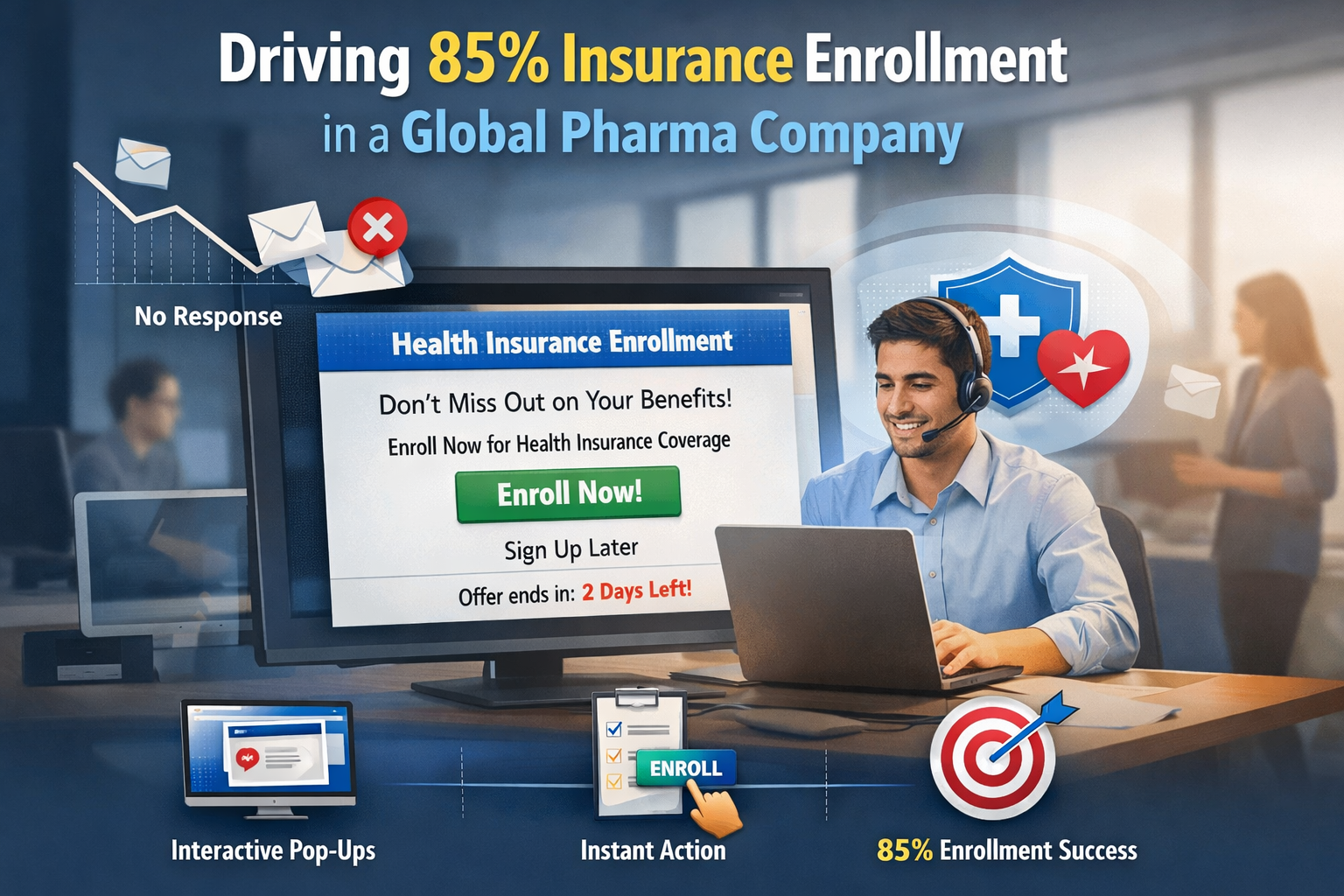
Instead of chasing employees through inboxes, the organization adopted a direct-to-endpoint engagement model using Anakage.
What Changed?
1. Communication Became Contextual
Messages were delivered directly on employee devices—within their active workflow.
2. Engagement Became Interactive
On-screen pop-ups replaced passive emails, capturing attention instantly.
3. Action Became Seamless
Employees could enroll instantly—without navigating multiple systems.
What Was Implemented
Using Anakage’s campaign capabilities, the organization deployed:
- Personalized, real-time on-screen pop-ups
- Behavior-based targeting (who has/hasn’t enrolled)
- Clear, action-driven messaging
- One-click enrollment options
- Automated follow-ups for non-responders
This transformed communication into guided, frictionless action.
The Result: 85% Enrollment
The impact was immediate and significant:
- 85% of employees enrolled in the insurance program
- Drastic improvement over email-driven campaigns
- Reduced manual follow-ups by HR teams
- Better employee experience with minimal effort
The Bigger Insight: Engagement at the Point of Attention
The success came down to one key principle:
Engage users where they already are—and enable action instantly.
Endpoint campaigns work because they:
- Eliminate dependency on inbox behavior
- Deliver messages in real-time
- Reduce friction between intent and action
- Personalize engagement dynamically
Beyond IT: Expanding to Business-Critical Use Cases
While endpoint engagement is often associated with IT use cases, its real power lies in going beyond IT.
This same approach can drive outcomes across the enterprise:
HR & Employee Experience
- Benefits enrollment (like this use case)
- Policy acknowledgments
- Training completion campaigns
Finance & Compliance
- Mandatory declarations
- Expense submission reminders
- Audit readiness actions
Operations & Business Teams
- Tool adoption campaigns
- Process adherence nudges
- Internal surveys and feedback
Security & Awareness
- Phishing simulations
- Security policy enforcement
- Compliance actions
Why This Matters
Organizations don’t lack communication channels—they lack effective engagement mechanisms.
By moving beyond IT and applying endpoint campaigns to business workflows, enterprises can:
- Drive higher participation rates
- Reduce operational overhead
- Improve employee experience
- Ensure compliance and adoption
Final Thoughts
If your organization is still relying on emails to drive critical actions, you’re leaving outcomes to chance.
The future lies in:
Communicate → Engage → Act (instantly)
And as this global pharma company demonstrated, the right strategy can turn negligible response into 85% adoption—quickly and at scale.