


For nearly two decades, IT Service Management (ITSM) platforms have helped organizations manage IT operations through structured processes like incident, problem, and change management. These systems were built around frameworks such as ITIL and were designed primarily for large enterprises managing complex infrastructure.
But the reality of modern IT has changed.
Today’s IT teams deal with distributed workforces, endpoint sprawl, security compliance, and constant operational tasks. The traditional ticket-centric model often struggles to keep up with these operational realities.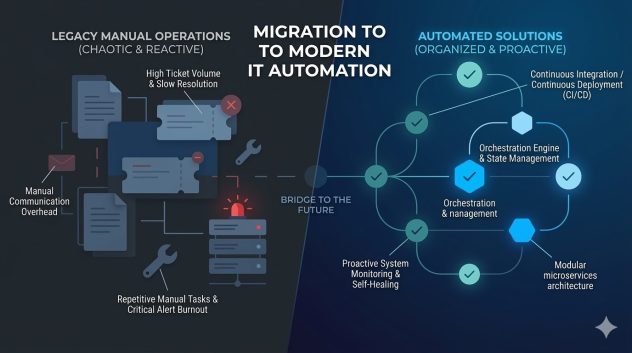

This is where Anakage takes a fundamentally different approach.
Instead of starting with ITIL processes, Anakage starts with the actual problems IT teams face every day.
Let’s explore how these two philosophies differ.
Contents
1. Product Philosophy
Traditional ITSM
Traditional ITSM platforms are process-first systems.
They are designed to ensure IT services follow defined governance structures. ork flows through structured processes such as:
-
Incident
-
Problem
-
Change
-
Request
-
Service catalog
The goal is governance and visibility.
Anakage
Anakage is built with an automation-first philosophy.
Instead of asking:
“How do we manage this ticket?”
Anakage asks:
“Why does this ticket exist in the first place?”
The goal is to eliminate repetitive work through automation, self-heal, and self-help capabilities.
Success is measured by work removed from the IT team, not tickets processed.
2. The Problem Each System Solves
Traditional ITSM
Traditional ITSM platforms primarily help organizations:
-
Govern IT services
-
Track tickets
-
Manage SLAs
-
Maintain CMDB records
They are excellent systems for tracking and auditing IT operations.
But they often do little to reduce operational workload.
Anakage
Anakage focuses on reducing the daily operational burden on IT teams.
It helps teams:
-
Automate repetitive admin tasks
-
Self-heal common endpoint issues
-
Enable users to fix problems themselves
-
Enforce compliance automatically
-
Manage distributed endpoints
The focus shifts from tracking work to removing work.
3. Deployment Speed
Traditional ITSM
ITSM deployments typically involve:
-
Process workshops
-
CMDB modeling
-
Workflow configuration
-
Service catalog design
-
Integrations
This often leads to deployments that take weeks or months.
Anakage
Anakage is designed for rapid operational value.
Teams can start using automation and endpoint intelligence within days, because the platform is focused on real operational tasks rather than complex process modeling.
4. Endpoint Reality vs Infrastructure Thinking
Traditional ITSM
Traditional systems were designed when IT was primarily about:
-
Data centers
-
Servers
-
Network infrastructure
-
Service uptime
Endpoints were often treated as assets in the CMDB rather than operational entities.
Anakage
Modern IT problems live at the endpoint layer.
Examples include:
-
Patch failures
-
Device misconfigurations
-
Software conflicts
-
Security policy violations
-
Lost or unmanaged devices
Anakage treats endpoints and users as the core operational surface, which is especially important for:
-
Remote work environments
-
Distributed teams
-
Small and mid-sized organizations
5. Ticket Dependency
Traditional ITSM
The ticket is the center of the system.
Everything starts with a ticket:
-
Incidents
-
Requests
-
Changes
-
Approvals
This often creates a paradox where the system succeeds when ticket volume increases.
Anakage
Anakage measures success differently.
Success means:
-
Fewer tickets
-
Automated fixes
-
Self-healing systems
-
Users solving issues themselves
Tickets become the exception, not the default.
6. Built for Different Types of Organizations
Traditional ITSM
Traditional ITSM platforms are optimized for:
-
Large enterprises
-
Dedicated IT governance teams
-
Mature ITIL environments
-
Complex multi-layer approvals
They are powerful but often heavyweight for smaller organizations.
Anakage
Anakage is designed for organizations where:
-
IT teams are small
-
Compliance still matters
-
Endpoint management is critical
-
Automation saves real time
It works especially well for companies where IT is not the core business, but operations still need to run smoothly.
7. Compliance: Documentation vs Enforcement
Traditional ITSM
Compliance is often handled through:
-
Documentation
-
Change records
-
Approval trails
-
Audit reports
This creates evidence of compliance.
Anakage
Anakage focuses on enforcing controls automatically.
Examples include:
-
Security configuration enforcement
-
Patch compliance monitoring
-
Endpoint policy validation
-
Automated remediation
Instead of documenting compliance after the fact, Anakage helps maintain compliance continuously.
The Bigger Shift: From Ticketing to Automation
Traditional ITSM systems helped organizations manage complexity.
But modern IT teams increasingly need tools that remove complexity.
The shift is happening from:
| Traditional ITSM | Anakage |
|---|---|
| Process-first | Automation-first |
| Ticket-centric | Task elimination |
| Governance focus | Operational efficiency |
| Infrastructure thinking | Endpoint-first |
| Weeks to deploy | Days to value |
Both models have their place.
But for many organizations today — especially those with distributed teams and limited IT bandwidth — the real value comes from automating operations rather than managing tickets.
And that is exactly where Anakage is designed to help.