


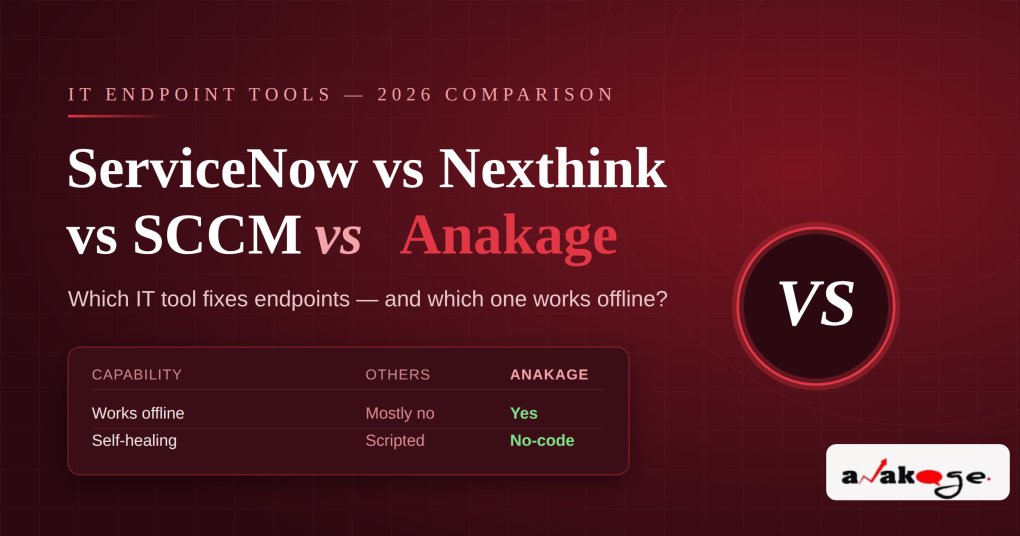
ServiceNow, Nexthink, SCCM, and Anakage each solve IT endpoint problems differently. ServiceNow records tickets. Nexthink observes and reports. SCCM pushes patches. Anakage detects and fixes issues directly, even offline. The right pick depends on your core problem, not the brand name.
This guide compares seven major tools against Anakage one by one. Every section includes a comparison table for a quick scan.
It is written for IT managers at Indian enterprises. You face audit deadlines, budget limits, and networks that are not always online.
Contents
- 1 Key Takeaways
- 2 How These Tools Differ at the Core
- 3 ServiceNow vs Anakage: What Is the Difference?
- 4 Nexthink vs Anakage: What Is the Difference?
- 5 SCCM vs Anakage: What Is the Difference?
- 6 Kaseya vs Anakage: What Is the Difference?
- 7 Systrack vs Anakage: What Is the Difference?
- 8 Riverbed vs Anakage: What Is the Difference?
- 9 Workelevate vs Anakage: What Is the Difference?
- 10 Master Comparison: All 7 Tools vs Anakage
- 11 Disclaimer
- 12 Frequently Asked Questions
- 13 The Bottom Line
Key Takeaways
- ServiceNow is best for enterprise ticketing and ITSM workflows.
- Nexthink and Systrack are best for analytics and observability.
- SCCM is best for Windows patch deployment at scale.
- Kaseya is best for MSPs managing many client networks.
- Riverbed is best for WAN and network performance.
- Anakage is best for offline, air gapped, and endpoint self-healing use cases.
- Only Anakage among these tools runs 100% offline with no-code self-healing.
How These Tools Differ at the Core
Each tool is built around one main idea. That core idea shapes what it does well and badly.
The biggest split is action versus insight. Some tools tell you what is wrong. Others actually fix it.
DEX — Digital Employee Experience, the measure of how smoothly staff use IT tools daily.
RMM — Remote Monitoring and Management, software used to manage endpoints from a central console.
DAP — Digital Adoption Platform, a layer that guides users inside an application.
ServiceNow vs Anakage: What Is the Difference?
ServiceNow is record-first. It logs issues into tickets and routes them through workflows.
It is strong for large enterprises needing structured service management. The trade-off is cost and speed.
ServiceNow uses modular licensing that adds up fast. Implementation often runs into months. It also needs custom code to fix endpoint issues natively.
Anakage is action-first. It fixes endpoint issues directly, often without a script, and works fully offline.
| Capability | ServiceNow | Anakage |
|---|---|---|
| Core philosophy | Record-first (ticketing) | Action-first (detect and fix) |
| Self-healing | Needs IntegrationHub plus code | Native, no-code |
| Offline capability | No (cloud-dependent) | Yes (100% offline) |
| In-app user guidance | Needs 3rd party like WalkMe | Built-in |
| Deployment time | Months | Days |
| Cost model | Modular, expensive | Bundled single license |
Quick answer: ServiceNow manages the ticket and workflow process. Anakage fixes the endpoint issue directly and works offline.
Nexthink vs Anakage: What Is the Difference?
Nexthink is insight-first. It combines real-time analytics with employee feedback.
It shows IT teams exactly what is happening across endpoints. For diagnosing patterns, it is strong.
The gap is action. Nexthink reports the problem but does not fix it natively. It is also cloud-dependent.
Anakage adds self-heal and offline support on top of insight. For disconnected network segments, that difference is the whole point.
| Capability | Nexthink | Anakage |
|---|---|---|
| Core philosophy | Insight-first (observability) | Action-first (detect and fix) |
| Self-healing | Limited (needs scripting) | Native, no-code |
| Offline capability | No (cloud-dependent) | Yes (100% offline) |
| In-app user guidance | No | Built-in |
| Deployment time | Weeks | Days |
| Cost model | High (analytics plus modules) | Bundled single license |
Quick answer: Nexthink shows you what is wrong using analytics. Anakage detects and fixes it, including offline.
SCCM vs Anakage: What Is the Difference?
SCCM from Microsoft is deployment-first. It pushes patches and software across Windows estates.
It is the standard for large Windows environments. The challenge is maintaining agent health across vast networks.
If an agent stops responding, patches can fail silently and an admin must intervene. It is also Microsoft-only.
Anakage acts as a “last mile” fixer. It repairs failed patches where an agent has stopped responding. Many teams run both together.
| Capability | SCCM | Anakage |
|---|---|---|
| Core philosophy | Deployment-first (push updates) | Action-first (detect and fix) |
| Self-healing | None (admin must intervene) | Native, no-code |
| Offline capability | Partial (policy cache only) | Yes (100% offline) |
| In-app user guidance | No | Built-in |
| Patch management | Primary tool; needs agent health | Last-mile fixer |
| Cost model | Included in MS license | Bundled single license |
Quick answer: SCCM pushes patches at scale. Anakage repairs the patches that fail and works fully offline.
Kaseya vs Anakage: What Is the Difference?
Kaseya is built for managed service providers. It offers monitoring, backup, security, and networking in one console.
For MSPs juggling many client networks, it centralises control. The concerns are support and contracts.
According to user reviews on platforms like G2, some users report support gaps and contracts that often involve multi-year commitments. Its automation is also script-heavy.
Anakage suits in-house enterprise IT rather than MSP fleets. It works offline and ships with no-code automation.
| Capability | Kaseya | Anakage |
|---|---|---|
| Core philosophy | MSP management (RMM) | Action-first (detect and fix) |
| Self-healing | Yes (script-heavy) | Native, no-code |
| Offline capability | No | Yes (100% offline) |
| In-app user guidance | No | Built-in |
| Best fit | MSP fleets | In-house enterprise IT |
| Cost model | High (multi-year commitments) | Bundled single license |
Quick answer: Kaseya fits MSPs managing client fleets. Anakage fits in-house enterprise IT on offline networks.
Systrack vs Anakage: What Is the Difference?
Systrack from Lakeside is insight-first observability. Its bots fire actions based on collected data.
It gives deep visibility into endpoint performance. The limits are offline support and user guidance.
Systrack runs through an online portal only. It has no in-app guidance and no offline password reset. It also lacks native server and AD automation.
Anakage covers offline endpoints and user-led fixes that Systrack leaves to its portal.
| Capability | Systrack | Anakage |
|---|---|---|
| Core philosophy | Insight-first (observability) | Action-first (detect and fix) |
| Self-healing | Yes (data-triggered bots) | Native, no-code |
| Offline capability | No (online portal only) | Yes (100% offline) |
| In-app user guidance | No | Built-in |
| Self-service password reset | No | Advanced (works offline) |
| Server and AD automation | Lacks native automation | Yes |
Quick answer: Systrack analyses endpoint data online. Anakage acts on it offline and resets passwords for offline users.
Riverbed vs Anakage: What Is the Difference?
Riverbed is network-first. It optimises WAN and overall network performance.
For bandwidth bottlenecks, it does a focused job. It is the odd one out here.
Riverbed targets infrastructure, not the endpoint or user. It has no desktop self-heal and is network-dependent.
Anakage targets endpoint downtime directly. If bandwidth is not your problem, Riverbed is not the match.
| Capability | Riverbed | Anakage |
|---|---|---|
| Core philosophy | Network-first (performance) | Action-first (detect and fix) |
| Self-healing | No (WAN optimisation focus) | Native, no-code |
| Offline capability | Network-dependent | Yes (100% offline) |
| In-app user guidance | No | Built-in |
| Primary focus | Infrastructure and network | Endpoint and user |
| Cost model | High (enterprise hardware) | Bundled single license |
Quick answer: Riverbed optimises the network. Anakage fixes the endpoint and the user experience.
Workelevate vs Anakage: What Is the Difference?
Workelevate is a digital workplace support tool. It is a close competitor on feature set.
It offers competitive pricing for general workplace support. The gaps sit in depth.
Workelevate has no full development studio and depends on scripting. It also lacks multilingual content management and a large solution library.
Anakage ships a no-code visual studio, 200+ pre-built solutions, and multilingual content. For a diverse Indian workforce, language support helps adoption.
| Capability | Workelevate | Anakage |
|---|---|---|
| Development studio | None | Full no-code studio |
| Automation | Scripting-dependent | Scriptless (no-code) |
| Multilingual content | No | Yes |
| Pre-built solutions | No data | 200+ |
| In-app guidance | No | Built-in |
| ITSM integration | Limited | Comprehensive |
Quick answer: Workelevate covers workplace support broadly. Anakage adds a no-code studio, 200+ solutions, and multilingual content.
Master Comparison: All 7 Tools vs Anakage
This table summarises all eight tools side by side for a fast decision.
| Capability | ServiceNow | Nexthink | SCCM | Kaseya | Systrack | Riverbed | Workelevate | Anakage |
|---|---|---|---|---|---|---|---|---|
| Core philosophy | Ticketing | Observability | Push updates | RMM | Observability | Network | Workplace support | Detect and fix |
| Self-healing | Code-based | Limited | None | Script-heavy | Data-triggered | No | Script-based | Native, no-code |
| Offline capability | No | No | Partial | No | No | No | No | Yes |
| In-app guidance | 3rd party | No | No | No | No | No | No | Built-in |
| Deployment time | Months | Weeks | Weeks | Weeks | Weeks | Weeks | Weeks | Days |
| Cost model | Expensive | High | MS license | High | High | High | Competitive | Bundled |
No single tool wins at everything. Match the tool to your core problem and your network reality.
For teams managing offline networks, Anakage offers a free demo at anakage.com/book-a-demo. Worth a look if that matches your setup.
Disclaimer
All competitor brand names, product names, logos, and trademarks mentioned in this article are the property of their respective owners. The comparative data presented above is compiled from publicly available product documentation, websites, and user reviews as of June 2026. Product features, capabilities, and licensing models are subject to change by the respective vendors. This guide is for informational purposes only; readers are encouraged to verify technical specifications directly with the vendors before making a purchasing decision.
Frequently Asked Questions
Q: What is the difference between ServiceNow and Anakage?
A: ServiceNow records and routes issues through tickets and workflows. Anakage detects and fixes endpoint issues directly, often without a script. Anakage also runs fully offline, while ServiceNow is cloud-dependent.
Q: What is the difference between Nexthink and Anakage?
A: Nexthink observes endpoint health using analytics but does not fix issues natively. Anakage detects and fixes them and works offline. Some teams pair an observability tool with an action tool like Anakage.
Q: Which IT tool works on air gapped networks?
A: Most tools here are cloud-dependent, including ServiceNow, Nexthink, and Systrack. Anakage is built to run 100% offline with local discovery. SCCM offers only limited policy caching offline.
Q: Is SCCM or Anakage better for patching?
A: SCCM is the primary tool for pushing patches at scale. If its agent stops responding, patches can fail silently. Anakage acts as a last-mile fixer that repairs failed patches, so many teams run both together.
Q: Which endpoint tool fixes issues without scripting?
A: Anakage offers no-code self-healing through a visual studio. SCCM, Kaseya, and Systrack rely heavily on scripting. ServiceNow needs custom code for native remediation.
Q: What is the best IT tool for offline networks?
A: For offline networks you need local discovery and no cloud dependency. Anakage is designed for this. Open source tools like OCS Inventory can suit smaller offline deployments.
Q: Which of these tools are cloud-only?
A: ServiceNow, Nexthink, and Systrack are cloud-dependent. Kaseya and Workelevate also need connectivity. SCCM is partial, and Anakage runs fully offline.
Q: Which tool is best for RBI audit and compliance in India?
A: Tools with offline compliance monitoring suit RBI audit needs in disconnected environments. Anakage offers compliance monitoring and audit-ready reports that work offline, which helps Indian banks and NBFCs.
The Bottom Line
There is no single best IT tool, only the best fit for your core problem. Map your main gap to the right category before you shortlist vendors.
If your environment is offline, compliance-heavy, and endpoint-focused, Anakage is worth evaluating. The team offers a no-pressure demo at anakage.com for IT managers comparing their options.