


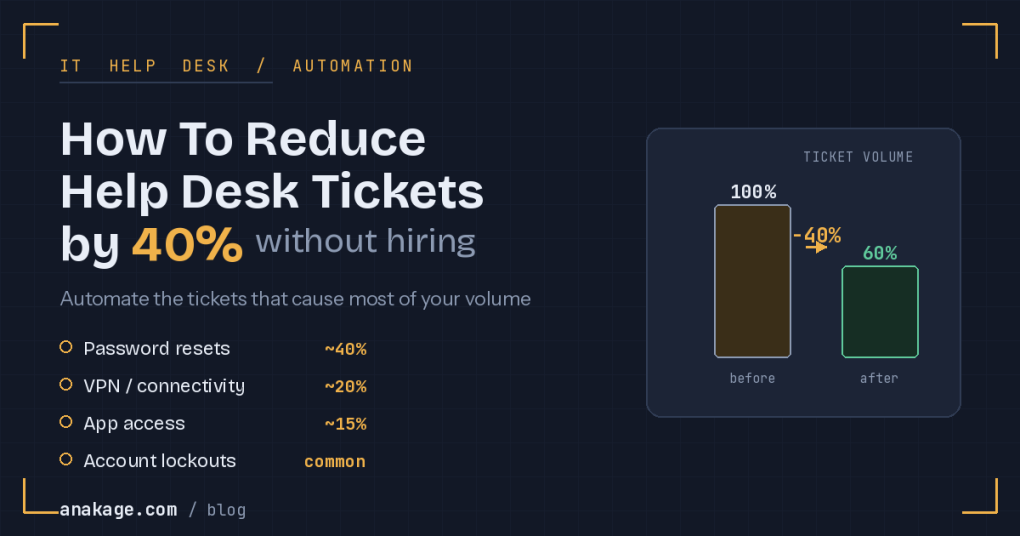
You reduce help desk ticket volume by automating the few ticket types that cause most of your load. In most companies, password resets, account lockouts, VPN issues, and app access make up the bulk of tickets. Automate those with self-service and self-healing, and a 30 to 40 percent drop is realistic without hiring anyone.
Most teams think high ticket volume means they need more staff. It usually means they need more automation.
Contents
What Causes Most Of Your Tickets
A few ticket types cause most of your volume. When you sort your tickets by category, the pattern is always similar.
Industry benchmarks show a typical mix: about 40 percent password resets, 20 percent VPN, and 15 percent app access. That means roughly three quarters of your tickets come from a handful of simple, repeated problems.
These are not hard tickets. They are the same easy ones, again and again. And anything that repeats can be automated.
Why Hiring More Agents Does Not Work
Hiring more agents does not fix high ticket volume. It just puts more people on the same repetitive resets and unlocks.
You end up paying to answer the tickets faster instead of removing them. The tickets keep coming back next week.
A common rule sums it up: if a large share of your tickets are password resets, that is a self-service problem, not a staffing problem. Adding staff cannot fix a self-service gap. Self-service can.
The Four Tickets To Automate First
You do not need to automate everything. Just fix the four categories that cause the most volume.
- Password resets. The biggest category almost everywhere. Self-service reset removes most of them.
- Account lockouts. Usually caused by an old password on a second device. Automated unlock handles most cases.
- VPN and connectivity. A steady, high-volume issue. Many are fixable with guided help or automated repair.
- App access and errors. Access requests and repeat app problems that follow the same steps every time.
Fix these four and you have covered most of your volume. Everything else is smaller.
How To Deflect These Tickets
There are three ways to resolve these tickets without an agent.
Self-service. Let users safely fix common issues themselves, like resetting a password after verifying who they are. The ticket becomes a two-minute self-serve action.
Self-healing. For problems on the device, an endpoint agent detects and fixes the issue automatically, often before the user notices. No ticket is ever raised.
Guided in-app help. For issues that need a user to act, walk them through it step by step inside the app, instead of a call to the help desk.
The idea is simple: move the fix away from the agent, to automation or the user.
What A 40% Cut Is Worth
A single password reset ticket costs around $70 once you count staff time and lost productivity.
Password tickets alone run at 20 to 50 percent of your workforce every year. For a 5,000-person company, reset costs are estimated at $350,000 to $1.5 million a year.
Self-service password reset is widely reported to cut reset tickets by 60 to 80 percent. Add lockouts, VPN, and app tickets, and a 30 to 40 percent cut in total volume is realistic.
The gain is more than money. Your agents stop doing repetitive resets and move to real work. Response times improve and backlogs shrink, all at the same headcount.
How Anakage Helps
Anakage removes repetitive endpoint tickets automatically.
It detects and fixes common device problems before they become a ticket. It guides users through fixes inside the app, so they self-serve instead of calling. It runs on-premise, so it works in regulated and offline setups. And it logs every fix, giving you an audit trail and clear data on what you have deflected.
Anakage is not your whole service desk. It is the automation layer that removes the repetitive endpoint tickets, so your team handles less noise.
Frequently Asked Questions
Q: How can I reduce help desk tickets without hiring? A: Automate the few ticket types that cause most of your volume: password resets, account lockouts, VPN issues, and app access. Self-service and self-healing can cut total volume by 30 to 40 percent with no new agents.
Q: What percentage of help desk tickets are password resets? A: Around 40 percent in most organizations, with benchmarks ranging from 20 to 50 percent. It is the single largest category, so it is the first thing to automate.
Q: Does self-service password reset really cut ticket volume? A: Yes. It is widely reported to cut reset tickets by 60 to 80 percent when set up well. Because resets are such a large share, that alone makes a big difference.
Q: Why does hiring more agents not help? A: More agents handle the same tickets faster but never remove them, so the volume returns. High reset or lockout volume is a self-service gap, and staffing cannot close it.
Q: What does one help desk ticket cost? A: About $70 for a password reset, once you count staff time and lost productivity. For a 5,000-person company, reset costs alone run $350,000 to $1.5 million a year.
Reducing help desk tickets is not about working faster. It is about removing the repetitive tickets for good, so your team stops fixing the same things over and over.
If you want to automate and deflect repetitive endpoint tickets, Anakage offers a demo at https://anakage.com/contact-us.html.