


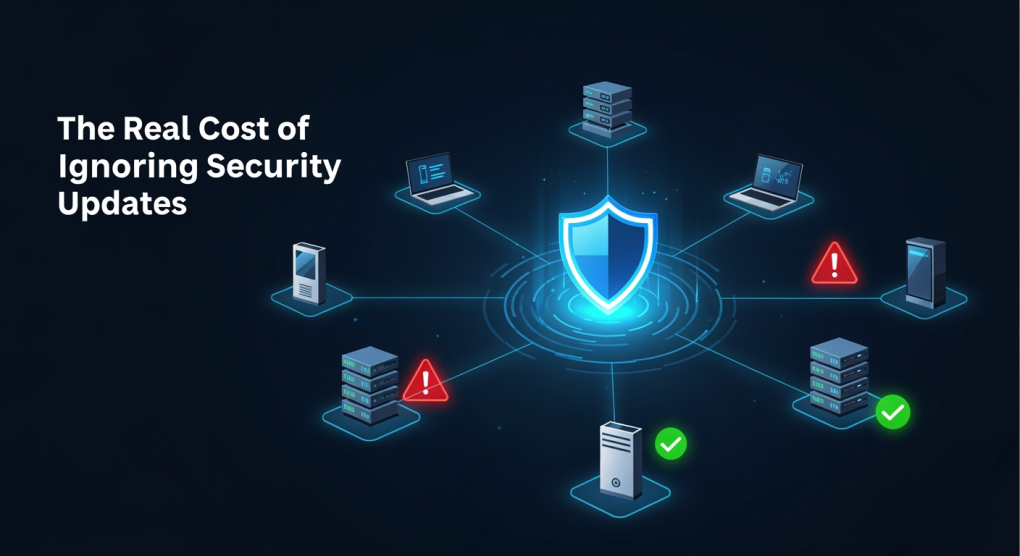
Delaying a security update feels harmless in the moment. The patch can wait until next week. The system is running fine. There are bigger priorities today. But for enterprise IT teams managing hundreds of endpoints, that delay has a documented, measurable cost — and it compounds every single day the update sits uninstalled.
Contents
What Actually Happens When You Skip a Security Update
Every unpatched device is an open door.
When a software vendor releases a security patch they are also publicly announcing that a vulnerability exists. Attackers read those announcements too. From the moment a patch is released, threat actors begin scanning networks for unpatched systems. The average time between a vulnerability disclosure and active exploitation is now under 15 days.
For an enterprise with 300 unpatched endpoints, that is 300 open doors — each one visible to anyone looking.
The Real Costs — By Category
1. Financial Cost of a Breach
The numbers are no longer abstract.
IBM’s Cost of a Data Breach Report puts the global average breach cost at $4.45 million. For Indian enterprises, the figure is lower but rising rapidly as regulatory penalties increase. A single breach traced to an unpatched vulnerability can include:
- Forensic investigation costs
- Legal and regulatory fees
- Customer notification expenses
- Downtime and recovery costs
- Reputational damage that affects revenue for years
No patch is worth $4 million in savings. But skipping patches systematically creates the conditions where that cost becomes possible.
2. Regulatory and Compliance Cost
For Indian enterprises this is the most immediate risk.
RBI mandates that banks and NBFCs maintain current patch levels across all endpoints. GDPR requires organisations handling European data to demonstrate active security maintenance. ISO 27001 certification requires documented patch management processes.
An IT audit that finds unpatched systems does not just result in a finding. It results in:
- Mandatory remediation with a deadline
- Follow up audit at your cost
- Potential penalty for non compliance
- In severe cases, operational restrictions
The cost of a compliance failure almost always exceeds the cost of the patch management system that would have prevented it.
3. Operational Downtime Cost
Unpatched systems are unstable systems.
Security vulnerabilities often cause performance degradation before they cause a breach. Unpatched software crashes more frequently, conflicts with other applications and creates IT support tickets at a higher rate. The cumulative cost of that lost productivity across an enterprise is significant and almost never tracked against patch management decisions.
Ransomware — which nearly always exploits known, patchable vulnerabilities — caused an average of 21 days of downtime per incident in recent reporting. For an enterprise, 21 days of disrupted operations is an existential event.
4. Hidden IT Cost
Manual patch management is expensive in ways that do not appear in any single budget line.
When patches are managed manually or inconsistently, IT teams spend hours each week:
- Identifying which devices need updates
- Manually pushing updates device by device
- Verifying successful installation
- Documenting patch status for audits
- Chasing down devices that missed the update cycle
That time has a salary cost. It also has an opportunity cost — every hour spent on manual patching is an hour not spent on strategic IT work.
Why Patch Management Fails in Enterprise Environments
Most IT teams understand the importance of patching. The problem is execution at scale.
Offline and air gapped networks — Many enterprise environments, particularly in banking, government and manufacturing, operate on networks with no internet connectivity. Standard patch management tools require cloud connectivity to function. On disconnected networks, patching either becomes entirely manual or stops happening consistently.
Endpoint sprawl — As organisations grow, the number of endpoints grows faster than the IT team’s capacity to manage them manually. A team that could manage 50 devices manually cannot manage 500 the same way.
Visibility gaps — You cannot patch what you cannot see. In environments without proper asset discovery, devices fall off the radar entirely. Those undiscovered devices are typically the most vulnerable — they have not been patched precisely because nobody knew they existed.
Inconsistent documentation — Even when patches are applied, proving it to an auditor requires complete documentation. Manual processes rarely produce the audit trail that compliance requires.
What a Proper Patch Management System Does
An enterprise grade patch management system removes the human bottleneck from the update cycle.
It discovers every endpoint automatically, identifies which devices are missing which patches, deploys updates according to a defined schedule, verifies successful installation and generates audit ready reports — all without requiring manual intervention for each device.
The result is a consistent patch posture across the entire endpoint estate, documented and defensible in any audit.
The Right Approach for Offline and Air Gapped Environments
This is where most standard tools fail Indian enterprises.
Tools built for cloud connected environments cannot function on offline or air gapped networks. They require internet access for patch downloads, device communication and reporting. In environments where internet connectivity is restricted by design — banking networks, government systems, secure manufacturing environments — these tools are simply not viable.
The right approach for offline environments requires:
- On premise deployment with no cloud dependency
- Local patch repository that stores updates internally
- Agent based discovery that works without internet access
- Automated deployment across disconnected network segments
- Compliance reporting generated entirely from local data
How Anakage Addresses This
For enterprise IT teams managing offline and air gapped networks, Anakage is built specifically for this environment.
It deploys entirely on premise, requires no cloud connectivity and manages patch deployment across disconnected endpoints automatically. Asset discovery, patch status tracking and compliance reporting all happen locally — with no data leaving your network.
For teams preparing for RBI, GDPR or internal audits, Anakage generates patch compliance reports on demand, giving auditors the documentation they require without manual compilation.
If your environment includes offline or air gapped networks and patch management is a current challenge, the Anakage team offers a 30 minute demo walkthrough at anakage.com. Worth a look before the next audit cycle begins.
FAQ
Q: How quickly can an unpatched vulnerability be exploited?
A: Research shows the average time between public vulnerability disclosure and active exploitation is under 15 days. In high profile cases it has been under 24 hours. Every day a patch goes uninstalled is a day of active exposure.
Q: What is the RBI requirement for patch management?
A: RBI guidelines require banks and NBFCs to maintain a documented patch management process covering all endpoints. This includes timely application of security patches, verification of patch status and audit ready documentation of the entire process.
Q: Can patch management work on air gapped networks?
A: Yes, but only with tools built specifically for offline environments. Standard patch management tools require internet connectivity. On premise tools with local patch repositories can manage updates across air gapped networks without any cloud dependency.
Q: How do you track patch status across hundreds of endpoints?
A: An automated patch management system with agent based discovery tracks patch status across every endpoint in real time. It identifies missing patches, deployment failures and devices that have not checked in — without manual verification of each device.
Q: What is the difference between a security patch and a feature update?
A: A security patch addresses a specific vulnerability or weakness in existing software. A feature update adds new functionality. Security patches are time critical because the vulnerability they fix is typically public knowledge. Feature updates can be scheduled at convenience. Both should be managed systematically but security patches should always be prioritised.
Q: How often should enterprise devices be patched?
A: Security patches should be applied within 30 days of release at maximum, with critical patches applied within 7 days. A documented patching schedule reviewed and approved by IT leadership is the standard most compliance frameworks expect.