
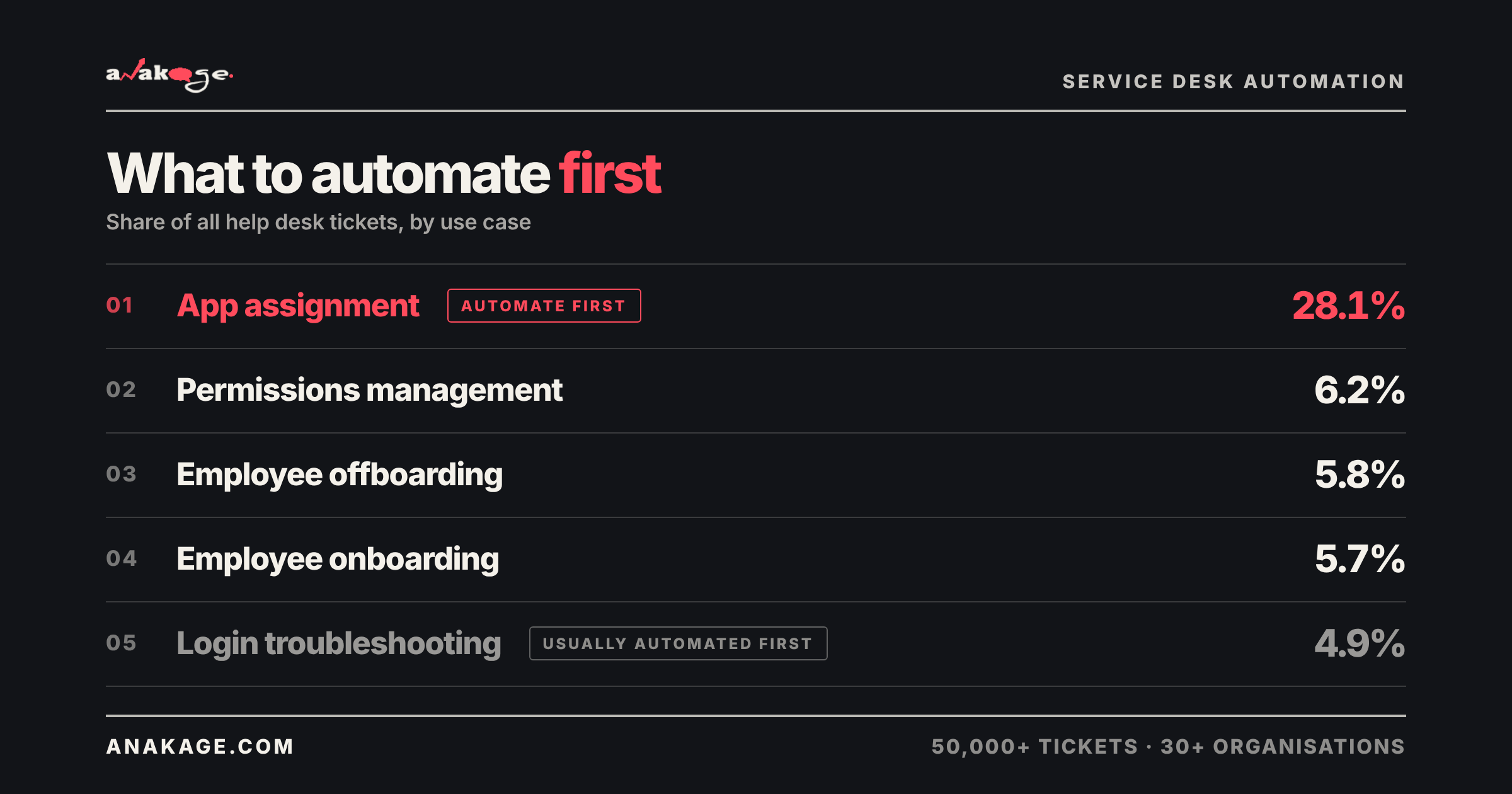
Start service desk automation with access and provisioning, not password resets. One published dataset of more than 50,000 tickets puts app assignment at 28.1 percent of all help desk volume. Login troubleshooting sits at 4.9 percent.
That is a 5.7 times difference in reach. Teams who start with password reset are automating the smallest category.
In our experience with enterprise IT teams, the blocker is rarely ambition. It is that provisioning touches identity, applications and the endpoint at once. Most tools cover only one of the three.
We built Anakage as one agent across all three layers. The ranking below follows the ticket data, and we show where our platform fits each category.
Service desk automation: software that resolves or fulfils IT requests without a human agent touching the ticket.
What the Ticket Data Says
Almost every article on common help desk tickets names password resets as the biggest group. Insight Global calls them “by far the most common help desk ticket.” Avatier calls them “usually the single largest category of help-desk contacts.”
One source publishes an actual dataset and disagrees. Fixify’s 2026 IT Help Desk Benchmark Report covers “50,000+ tickets across 30+ organizations over 14 months.” Its opening line is “It’s not password resets.”
| Use case | Share of all tickets |
|---|---|
| App assignment | 28.1% |
| Permissions management | 6.2% |
| Employee offboarding | 5.8% |
| Employee onboarding | 5.7% |
| Login troubleshooting | 4.9% |
App assignment is more than four times the second-place use case. The top three together make up 40 percent of tickets. More than 40 other use cases share the remaining 60 percent.
| Category | Share of all tickets |
|---|---|
| Software and applications | 38.2% |
| Onboarding and offboarding | 16.6% |
| Identity and access management | 15.9% |
| Collaboration | 11.7% |
| Hardware | 8.4% |
| Security | 3.7% |
| Connectivity | 2.4% |
Those first three categories come to 70.7 percent of all tickets. Every one of them is provisioning and access work.
Employee lifecycle cuts across them. Employee and contractor onboarding and offboarding together account for 16 percent of tickets.
Why Password Reset Automation Is Overrated
Password reset is the standard first automation project. It is also low volume and technically fragile.
It Breaks on Hardened Windows Builds
Microsoft documents settings that interfere with resets from the Windows sign-in screen. Its wording is “The following settings are known to interfere with the ability to use and reset passwords on Windows 10 devices.”
Settings Microsoft names individually include:
HideFastUserSwitchingset to EnabledDontDisplayLastUserNameset to EnabledNoLockScreenset to EnabledBlockNonAdminUserInstallset to EnabledEnableLostModeset on the deviceExplorer.exereplaced with a custom shell- Interactive logon: Require smart card, set to Enabled
Microsoft also documents a combination. Its wording is “The combination of the following specific three settings can cause this feature to not work.” Those three are:
- Interactive logon: Do not require CTRL+ALT+DEL, set to Disabled, on Windows 10 version 1710 and earlier
DisableLockScreenAppNotificationsset to Enabled- Windows Home edition
Several of those are normal security hardening. A team can harden its endpoints, automate password reset, then find the reset option does not work.
The Cached Credential Catch
Hybrid-joined machines have a second trap. Microsoft states these devices “must have network connectivity line of sight to a domain controller to use the new password and update cached credentials.”
The qualifier matters. Microsoft adds that “If SSPR is the only requirement, the network connection line to the domain controller isn’t required.”
So a remote user can reset their password and still fail to log in, because the cached credential never updated. The reset worked and the ticket still arrives.
Service Desk Automation Use Cases, Ranked for 2027
Work down this list instead of starting with the most talked-about use case. We have mapped each one to how our platform handles it. Compare that against whatever you are evaluating.
- Automate app assignment first. It is 28.1 percent of volume, and most requests follow the same approve-then-provision path.
- Automate joiner and leaver workflows next. Those lifecycle cases are 16 percent of tickets, and they create compliance risk when they lag.
- Automate permissions changes third, at 6.2 percent. Role changes and project moves generate these continuously.
- Automate software deployment and updates. This sits inside the 38.2 percent software and applications group.
- Automate endpoint self-heal for recurring faults. Disk space, stuck services and crash loops repeat predictably.
- Automate compliance evidence collection. Audit reporting is slow manual work that machines do better.
- Automate password reset last. Test it against your hardened build before you promise it.
Why This Order Changes the Return
Only ticket volume scales a saving. Automating a 28.1 percent slice returns about five times what the same effort returns on a 4.9 percent one.
Provisioning work has a second advantage. The same request produces the same steps every time. That is far easier to automate than diagnosing a slow laptop.
How Anakage Covers the Top Categories
We built Anakage around this problem. Our platform runs as one agent across the endpoint, identity and the application layer, which is what provisioning automation needs.
Our site describes the platform as including “incident, service request, problem and change management, CMDB, asset management, patch management, software deployment, endpoint management, self-service, automation, and compliance monitoring through a unified platform and agent.”
| Ticket category | Share of volume | What Anakage does |
|---|---|---|
| Software and applications | 38.2% | Zero-touch software deployment, software metering and SAM, patch and vulnerability remediation |
| Onboarding and offboarding | 16.6% | Onboarding and offboarding workflows, app and access provisioning |
| Identity and access management | 15.9% | IAM automation, Active Directory task automation, password reset and unlock |
| Collaboration | 11.7% | Guided walkthroughs, virtual AI agent, self-service portal |
| Hardware | 8.4% | Endpoint health and telemetry, disk cleanup and tune-up, physical asset verification |
That covers 90.8 percent of the Fixify ticket mix with one agent rather than a separate tool per layer.
A Joiner Workflow End to End
Our site publishes a worked example of a new hire request running across four systems:
- An Active Directory account and mailbox created
- Licences and app access assigned in Intune
- Apps and a welcome ticket provisioned in ServiceNow
- Endpoint compliance verified by Anakage
The stated result is completion in 38 seconds, with zero tickets raised and a full audit trail. That is the shape of provisioning automation when identity, apps and endpoint are handled together.
What Our Customers Have Published
These are outcomes from our own case studies, each with a write-up on our site.
| Result | Environment |
|---|---|
| 80 percent plus faster enterprise software rollouts | Manufacturing, 1,000+ users |
| 60 percent faster employee onboarding | Logistics, WMS rollout |
| 100 percent of routine Active Directory operations automated | Telecom infrastructure |
| 40 percent lower mean time to resolution | Financial services, 5,000 endpoints |
| 20,000 users supported through automation | 1,200+ branches |
| 5,000+ endpoints continuously audit-ready | Pharma, regulated |
The manufacturing figure is the clearest provisioning example. Our case study describes SAP deployment moving “from hours per user to a largely automated process across more than 1,000 employees.”
These are our own numbers. Ask us for the customer reference behind any of them, which we provide on request.
Why One Agent Matters Here
Provisioning automation fails when it only covers part of the chain. An onboarding run that creates the account but misses one app access still generates a ticket.
Anakage runs more than 20 capabilities through a single agent. Those include DEX, self-heal, patching, ITSM, ITAM, software deployment and the self-service portal. One agent means one install, one set of credentials and one audit trail across the joiner workflow.
We are also realistic about where we fit. Our site says plainly that “many customers use Anakage alongside existing investments as an automation, remediation, compliance, and endpoint operations layer” while “others choose to consolidate parts of their stack over time.”
You do not have to replace ServiceNow, SCCM, Intune or Jira to use us. Larger teams usually start with one use case, such as IAM automation or software deployment. They expand once it proves out.
Built for Indian Enterprise Conditions
Indian enterprises plan on an April financial year. So automation scoping tends to run January to March.
Search demand for the category is real. “ITSM tools” draws 2,900 searches a month in India, on Ubersuggest data pulled 3 November 2026.
Provisioning automation hits one local limit. BFSI and manufacturing environments often restrict endpoint scripting through Constrained Language Mode, AppLocker or WDAC. Ask any vendor how its automation runs under those controls.
This is the constraint we were built around. Our platform supports “cloud, on-premise, hybrid, disconnected, and fully air-gapped environments with no cloud dependency required,” and our optional agentic AI layer runs on-premise on your own models with a full audit trail.
We currently manage more than 2.5 million endpoints across 100 plus enterprises in 12 plus countries. We hold SOC 2 Type 1, SOC 2 Type 2 and ISO 27001, and we are GDPR compliant. Indian enterprises on our customer list include Airtel, HDB Financial Services and Indus Towers.
Most deployments take four to six weeks depending on scope.
Where Service Desk Automation Fails
Three failure patterns are worth planning around, including on our own platform.
Automating the ticket close rather than the fix is the most common. A reopen rate above 10 percent after launching an auto-resolver means tickets are closing early.
Partial provisioning is the second. An onboarding automation might create the account but miss one app access. That generates a second ticket and destroys the saving.
The long tail is the third. More than 40 use cases share 60 percent of volume, so each one on its own returns very little. We tell prospects to automate the top categories and leave the tail alone.
What We Could Not Verify
Seven gaps sit behind the figures above.
- Fixify sells help desk services. This is vendor-published data from its own customer base, not an independent survey. It does state its method, which most vendor figures do not.
- No second dataset confirms the 28.1 percent figure. We found no independent benchmark of ticket mix at this sample size.
- The sources naming password resets as the top category do not publish datasets. We could not test their claim against numbers.
- Fixify groups some categories as others. The seven categories we list therefore do not total 100 percent.
- Microsoft’s interference list may hold more entries than we quote. Our capture returned one list item incompletely, so we name only what we could read in full.
- Our own case study outcomes are self-reported, and we have not published the underlying ticket data. Treat them as a starting point for questions.
- No India-specific ticket mix data exists that we could find. The category shares above are not split by country.
Frequently Asked Questions
Q: What is service desk automation?
A: It is software that resolves or fulfils an IT request without a human agent handling the ticket. That covers endpoint self-heal, automated provisioning, and workflows that run across systems. Ticket routing is different, because a person still has to act.
Q: What should we automate first on the service desk?
A: Start with app assignment and access provisioning. One benchmark of 50,000 plus tickets puts app assignment at 28.1 percent. Login troubleshooting is 4.9 percent. Provisioning requests also repeat the same way, so they automate more reliably.
Q: What are the most common help desk tickets?
A: Fixify’s 2026 benchmark ranks app assignment first at 28.1 percent. Permissions management follows at 6.2 percent, then employee offboarding at 5.8 percent. Many other sources name password resets instead, without publishing a dataset.
Q: Is password reset automation worth doing?
A: Yes, but later than most teams assume. Login troubleshooting is under 5 percent of volume in the one published dataset we found. It also breaks on several standard Windows hardening settings, so test it on your real build first.
Q: Why does self-service password reset fail on some laptops?
A: Microsoft lists several settings that interfere with resets from the sign-in screen. Those include DontDisplayLastUserName and NoLockScreen. Hybrid-joined devices also need line of sight to a domain controller. Without it, the reset works but the login still fails.
Q: Do we have to replace our existing ITSM tool to automate provisioning?
A: No. Many of our customers run Anakage alongside ServiceNow, SCCM, Intune or Jira as an automation and remediation layer. Others consolidate parts of the stack over time. Starting with one use case is the common path at enterprise scale.
Q: Does service desk automation work in air-gapped environments?
A: It depends whether the automation runs locally or calls a cloud service. Anakage supports on-premise, disconnected and fully air-gapped deployment with no cloud dependency. Ask any vendor how its agent behaves with no internet route and under endpoint scripting restrictions.
Q: How long does provisioning automation take to deploy?
A: Most Anakage deployments take four to six weeks depending on scope and environment complexity. Starting with a single high-volume use case such as app assignment shortens that. Ask any vendor for a scoped timeline rather than a platform-wide one.
Service desk automation pays off in line with the ticket volume it covers, and provisioning is where that volume sits. Pull your own ticket mix by category before you pick a first project.
If app assignment and onboarding dominate your queue, our team runs a demo on your own systems. It walks a joiner workflow end to end. Worth 30 minutes if provisioning is where your tickets sit.
Publishing Notes for the Web Team
Add FAQ schema markup and Article schema to this post.
Keep the year out of the URL. Two existing posts, dex-software-pricing-2026 and sccm-alternatives-2026, carry the year in the slug and need a redirect or republish every January. Put 2027 in the H1, the title tag and the meta description instead, and update dateModified on each refresh.
Internal linking, and one cannibalisation warning. Link to the existing ticket-deflection-rate post from the failure section, since the reopen-rate point is covered there in depth. Link the case study rows to their individual write-ups. The unpublished self-service password reset draft overlaps the password section here. Publish that draft as a linked deep dive from this page, or fold it in and drop it. Do not publish both as standalone pages targeting the same intent.
Positioning note. This version is deliberately Anakage-forward and exceeds the two-mention limit in blog-guidelines.md. Every Anakage claim is quoted or drawn from the live site as of 3 November 2026. No competitor is criticised anywhere in the post.
Sources
- Fixify, 2026 IT Help Desk Benchmark Report: https://www.fixify.com/it-help-desk-benchmark-report-2026
- Fixify, “What are the most common IT help desk tickets”: https://www.fixify.com/blog/most-common-it-help-desk-tickets
- Microsoft, Self-Service Password Reset for Windows Devices: https://learn.microsoft.com/en-us/entra/identity/authentication/howto-sspr-windows
- Insight Global, most common help desk tickets: https://insightglobal.com/blog/common-help-desk-tickets/
- Avatier, reducing password-reset tickets: https://credentialgovernance.avatier.com/en/blog/reducing-help-desk-password-tickets-2026
- ScreenMeet, IT help desk metrics: https://www.screenmeet.com/blog/it-help-desk-metrics-you-should-be-tracking