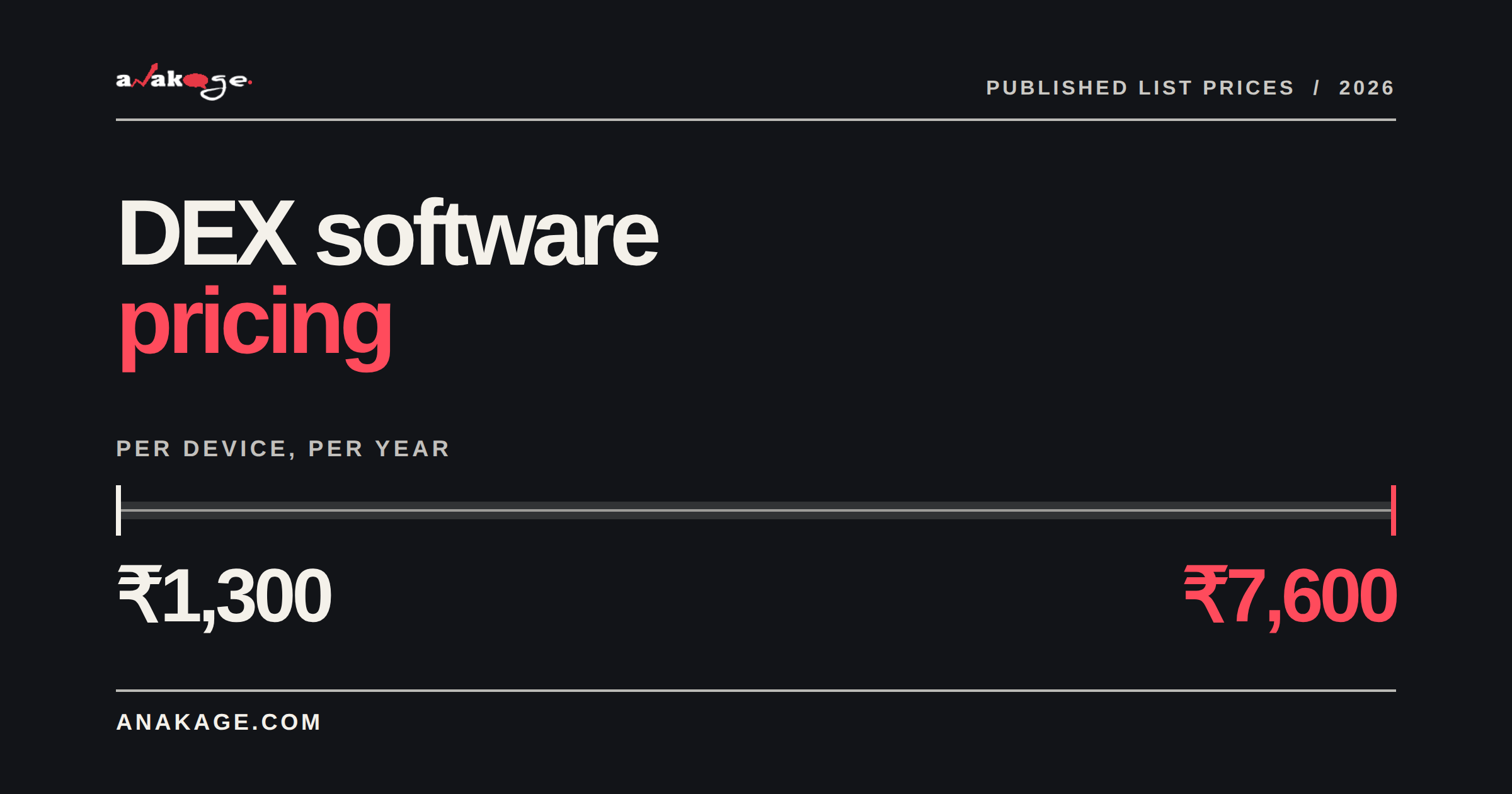
DEX software pricing runs from roughly ₹1,300 to ₹7,600 per device per year at published list rates. Almost every vendor hides this behind a quote form. We pulled real figures from UK government rate cards, AWS Marketplace listings and a Forrester study that Lakeside commissioned itself.
Every number below is public and linked. None of it came from a sales conversation or a leaked quote.
DEX — digital employee experience. Software that measures how well endpoints, applications and networks actually perform for employees, usually through an agent on each device.
DEX Software Pricing at a Glance
Published annual list prices, per device, converted at £1 = ₹125.67 and $1 = ₹94.55 (rates as of 19–21 October 2026):
| Product | List price | In ₹ | Source |
|---|---|---|---|
| Riverbed Aternity Enterprise | $80.16 | ₹7,579 | AWS Marketplace, 12-month contract |
| Riverbed Aternity Essentials | $57.24 | ₹5,412 | AWS Marketplace, 12-month contract |
| ControlUp | £25–£27 | ₹3,142–₹3,393 | G-Cloud 14 listing (reseller HTG) |
| Lakeside SysTrack | $33.00 | ₹3,120 | Forrester TEI commissioned by Lakeside |
| Nexthink Workplace Experience (1–1,000 devices) | £24.51 | ₹3,080 | G-Cloud 14 pricing document |
| Nexthink Workplace Experience (10,001+ devices) | £18.51 | ₹2,326 | G-Cloud 14 pricing document |
| ManageEngine Endpoint Central, UEM (1,000 endpoints) | $16.30 | ₹1,541 | ManageEngine Q1 2026 pricing |
| ManageEngine Endpoint Central, Enterprise (1,000 endpoints) | $14.05 | ₹1,328 | ManageEngine Q1 2026 pricing |
The spread is 5.7x from cheapest to most expensive. Within DEX proper, Nexthink and SysTrack land within 1% of each other.
ManageEngine sits lower because Endpoint Central is a UEM tool, not a DEX platform. It is in the table because Indian buyers shortlist it against DEX tools constantly.
Three caveats before you use these numbers
- The Nexthink and ControlUp figures are UK public-sector framework prices. Commercial pricing in India will differ.
- The Nexthink document is dated 6 May 2024 and covers a 3-year term. It states fees may change on 30 days’ notice.
- List price is a ceiling, not a forecast. Enterprise discounts of 30–50% are routine at volume.
Why These Prices Are Public When Vendors Say They Are Not
Two places force disclosure.
UK G-Cloud. Vendors selling to UK government must publish a rate card on the Digital Marketplace. Nexthink’s G-Cloud 14 document lists per-device tiers, minimum spend and implementation costs.
Cloud marketplaces. AWS and Azure listings carry real contract prices. Riverbed publishes per-device SKUs on AWS Marketplace with prices against each one.
G-Cloud — a UK government procurement framework. Suppliers list services and publish pricing documents that anyone can download.
Nexthink’s own AWS listing shows how thin this transparency can get. It prices four modules at $2,400 per 12 months each, but never defines what one “unit” is. Published is not the same as useful.
The Minimum Subscription Nobody Mentions
Here is the figure that changes shortlists.
Nexthink’s G-Cloud document sets a minimum subscription of £29,000 per year per instance. Below about 1,183 devices, that minimum decides your bill, not the per-device rate.
What that does to effective cost:
| Devices | Per-device list rate | What you actually pay | Effective cost per device |
|---|---|---|---|
| 250 | £24.51 | £29,000 | £116.00 |
| 500 | £24.51 | £29,000 | £58.00 |
| 750 | £24.51 | £29,000 | £38.67 |
| 1,000 | £24.51 | £29,000 | £29.00 |
| 1,500 | £22.29 | £33,435 | £22.29 |
| 5,000 | £20.39 | £101,950 | £20.39 |
A 500-device company pays 2.4x the advertised rate. A 250-device company pays 4.7x.
This is not a trick. It is the economics of enterprise DEX. The platform costs the same to run whether you monitor 200 endpoints or 2,000, so vendors set a floor.
The practical conclusion: if you run under 1,200 endpoints, enterprise DEX tools are priced against you. Look at UEM tools with experience features, or at vendors built for smaller estates.
Implementation Can Add 67% to Year One
Per-device licensing is the number in the proposal. It is not the number in your budget.
Nexthink publishes four fixed implementation packs on G-Cloud 14:
- Foundation Basic — £14,000
- Foundation Essentials — £30,000
- Foundation Extended — £47,000
- Foundation Enterprise — £117,500
Professional services run £1,350 per day onshore and £560 per day offshore.
Year one for a 2,000-device deployment:
| Scenario | Licence | Implementation | Year one total | Per device |
|---|---|---|---|---|
| Licence only | £44,580 | — | £44,580 | £22.29 |
| + Foundation Basic | £44,580 | £14,000 | £58,580 | £29.29 |
| + Foundation Essentials | £44,580 | £30,000 | £74,580 | £37.29 |
| + Foundation Extended | £44,580 | £47,000 | £91,580 | £45.79 |
Foundation Essentials pushes your real year-one cost 67% above the quoted rate. At ₹125.67 to the pound, that deployment costs about ₹93.7 lakh in year one.
Implementation dilutes as you scale. The same Foundation Essentials pack across 10,000 devices adds only £3 per device.
The Automation Layer Is Often a Separate SKU
Most DEX tools charge extra to act on what they find. Riverbed’s AWS Marketplace listing makes this unusually visible.
| SKU | Published price |
|---|---|
| Aternity Enterprise licence | $80.16 per device / 12 months |
| Riverbed IQ base (200,000 node executions/month) | $200,400 per tenant / 12 months |
| Riverbed IQ, additional 100,000 nodes/month | $51,600 per tenant / 12 months |
Riverbed IQ is the automation and remediation engine. It is priced per tenant, not per device, and it is a six-figure line item on its own.
At 5,000 devices the maths gets uncomfortable:
- Aternity Enterprise licences: $400,800 per year
- Plus Riverbed IQ base: $601,200 per year, about ₹5.68 crore
The automation layer is 33% of that bill. You can buy the visibility without it, which is exactly how many organisations end up with dashboards and no fixes.
Nexthink splits similarly. Its G-Cloud document lists Employee Engagement, Application Experience, Collaboration Experience, Amplify, Experience Central and Flow as separate modules, with no prices published for any of them. Workplace Experience includes only “limited-use versions” of two.
A senior architect at TCS put it plainly on PeerSpot: Nexthink “requires a license for almost everything.”
Ask for the module list and the price of each one before you compare anything.
Small Deployments Pay Far More Per Endpoint
ManageEngine publishes its pricing openly, which makes the volume curve easy to see. Endpoint Central cloud, annual, per endpoint:
| Edition | 50 endpoints | 250 endpoints | 1,000 endpoints |
|---|---|---|---|
| Professional | $20.90 | $14.98 | $11.24 |
| Enterprise | $24.90 | $18.78 | $14.04 |
| UEM | $27.90 | $21.78 | $16.30 |
| Security | $40.90 | $31.38 | $23.50 |
Per-endpoint cost falls 46% between 50 and 1,000 endpoints on the Enterprise edition.
Two things follow. Any per-device price you read is meaningless without the device count attached. And a quote for 400 endpoints tells you nothing about what 4,000 will cost.
ManageEngine also offers a free edition for up to 25 endpoints, and on-premises Professional from $795 per year for 50 endpoints.
What Buyers Actually Report Paying
Vendor-reported prices and buyer experience rarely match. PeerSpot reviewers rate Nexthink’s cost 6 to 9 out of 10, where 10 is most expensive.
A senior subject-matter expert at Microland reported that Nexthink runs “about 10% more expensive than SysTrack” but called the premium justified. Our table shows the two within 1% at list price, which suggests the gap shows up in modules and services rather than the headline rate.
Several reviewers described per-device monthly billing. Nexthink’s G-Cloud document uses annual per-device pricing on a 3-year term. Contract structure clearly varies by region and route to market.
No PeerSpot reviewer published an actual figure. That is the normal state of this market, and it is why the framework and marketplace documents matter.
How to Compare DEX Software Pricing Properly
Five steps that take about a week.
- Fix your device count first. Separate physical, virtual and mobile. Every quote keys off this number, and changing it later resets the discount.
- Ask for the module list with a price against each line. Request the figure for every module, not a bundle total. The gap between core and complete is where budgets break.
- Ask for the minimum annual commitment in writing. Under 1,200 endpoints this single number may rule a vendor out entirely.
- Get implementation quoted as a fixed pack. Day rates on an open scope are how a £45,000 licence becomes a £90,000 year one.
- Model year one and year three separately. Implementation hits once. Licensing compounds. A tool that looks cheap in year one can cost more across the term.
Then check the published sources yourself. Pull the vendor’s G-Cloud pricing document and its AWS or Azure listing before your first call. Walking in with their own rate card changes the conversation.
What Published Prices Do Not Tell You
Three costs sit outside every rate card.
Agent overhead. DEX agents consume RAM on every endpoint. Reported idle footprints range from about 50MB to 180MB depending on the tool. On older hardware, that cost lands on the employee.
Server infrastructure. On-premises deployments need servers, storage and database licences. Cloud deployments move that cost into the subscription, which is part of why cloud list prices look higher.
Automation capability you cannot use. Many remediation engines need PowerShell enabled on endpoints. Banks and NBFCs running Constrained Language Mode, WDAC or AppLocker often cannot use them. We have written separately about endpoint remediation without PowerShell.
That last one matters most in India. If your estate is air-gapped, partially offline, or locked down for RBI or IRDAI audit, a cheaper licence that cannot execute a fix is not cheaper. Tools built for those constraints — Anakage among them, alongside on-premises options like SCCM with third-party add-ons — price and behave differently from cloud-first DEX platforms.
FAQ
Q: How much does DEX software cost per device?
A: Published list prices range from about $14 to $80 per device per year, or roughly ₹1,300 to ₹7,600. Nexthink lists £24.51 at 1,000 devices falling to £18.51 above 10,000. Riverbed Aternity Enterprise publishes $80.16 per device per year on AWS Marketplace.
Q: Why do DEX vendors not publish pricing?
A: Pricing depends on device count, module selection, contract term and region, so vendors prefer to quote. They do publish on UK G-Cloud and on AWS and Azure marketplaces, where framework rules require it. Those documents are free to download.
Q: What is the minimum spend for Nexthink?
A: Nexthink’s G-Cloud 14 pricing document states a minimum subscription of £29,000 per year per instance. Below roughly 1,183 devices, that minimum sets your bill rather than the per-device rate. A 500-device deployment works out at about £58 per device.
Q: Is SysTrack cheaper than Nexthink?
A: At list price they are nearly identical. A Forrester study commissioned by Lakeside puts SysTrack at $33 per device per year across 40,000 endpoints. Nexthink’s published rate at that volume is £18.51, about $25. Module and services pricing usually decides the real difference.
Q: How much should I budget for implementation?
A: Nexthink publishes fixed packs from £14,000 to £117,500. For a 2,000-device deployment, a £30,000 pack raises year-one cost 67% above the licence alone. Always ask for a fixed-price pack rather than open-ended day rates.
Q: Is DEX software worth it under 1,000 endpoints?
A: Rarely, at enterprise DEX pricing. Minimum subscriptions mean small estates pay two to five times the advertised per-device rate. UEM tools with experience features, or vendors built for smaller estates, usually fit better below that threshold.
Q: Do these UK prices apply in India?
A: Not directly. G-Cloud figures are UK public-sector framework prices in GBP on a 3-year term. They are useful as a ceiling and a structural guide, showing how tiers, minimums and modules work. Indian commercial pricing is negotiated separately.
Q: What hidden costs should I check for?
A: Module licensing beyond the core platform, implementation and professional services, server infrastructure for on-premises deployments, and agent overhead on older endpoints. Also confirm whether the remediation engine needs PowerShell, which many locked-down Indian banking environments disable.
The Short Version
DEX software list prices sit between ₹1,300 and ₹7,600 per device per year, and the minimum subscription matters more than the rate if you run fewer than 1,200 endpoints. Modules and implementation routinely add 30 to 67% on top of the licence figure in any proposal.
If your environment is offline, air-gapped or locked down for audit, the cheapest licence is often the one that cannot run a fix. Anakage offers a free 30-minute demo for teams managing those constraints — worth a look if that matches your setup. Book a demo.
Sources
- Nexthink Infinity G-Cloud 14 pricing document — UK Crown Commercial Service Digital Marketplace, 6 May 2024
- Nexthink Infinity on AWS Marketplace
- Riverbed Aternity on AWS Marketplace
- ControlUp — Client-side/End Point monitoring, G-Cloud 14 listing — supplier Howell Technology Group
- The Total Economic Impact of Lakeside Digital Experience Cloud — Forrester Consulting, commissioned by Lakeside Software
- ManageEngine pricing guide 2026 — SuperOps, citing ManageEngine Q1 2026 pricing; note SuperOps competes with ManageEngine
- ManageEngine Endpoint Central store
- Nexthink pricing and cost discussion — PeerSpot
- Nexthink pricing — TrustRadius
- TeamViewer DEX pricing — tiers listed, no prices published
- Exchange rates: GBP/INR via OFX (19 October 2026), USD/INR via Pound Sterling Live (21 October 2026)