
Six of the ten most-recommended endpoint management tools are cloud-only. If your data cannot leave your network, your shortlist is shorter than the market suggests.
The ones that still deploy on-premises: ManageEngine Endpoint Central, HCL BigFix, Tanium, Motadata ServiceOps, N-able N-central and Lakeside SysTrack. Intune, NinjaOne, Action1, Atera, Automox, Ivanti Neurons and Scalefusion are cloud by design. (Sources: Motadata, July 2026; vendor deployment documentation)
One distinction decides which of them will actually work for you, and plenty of teams only find it after signing.
On-Premise and Offline Are Not the Same Thing
Most evaluations merge two separate questions.
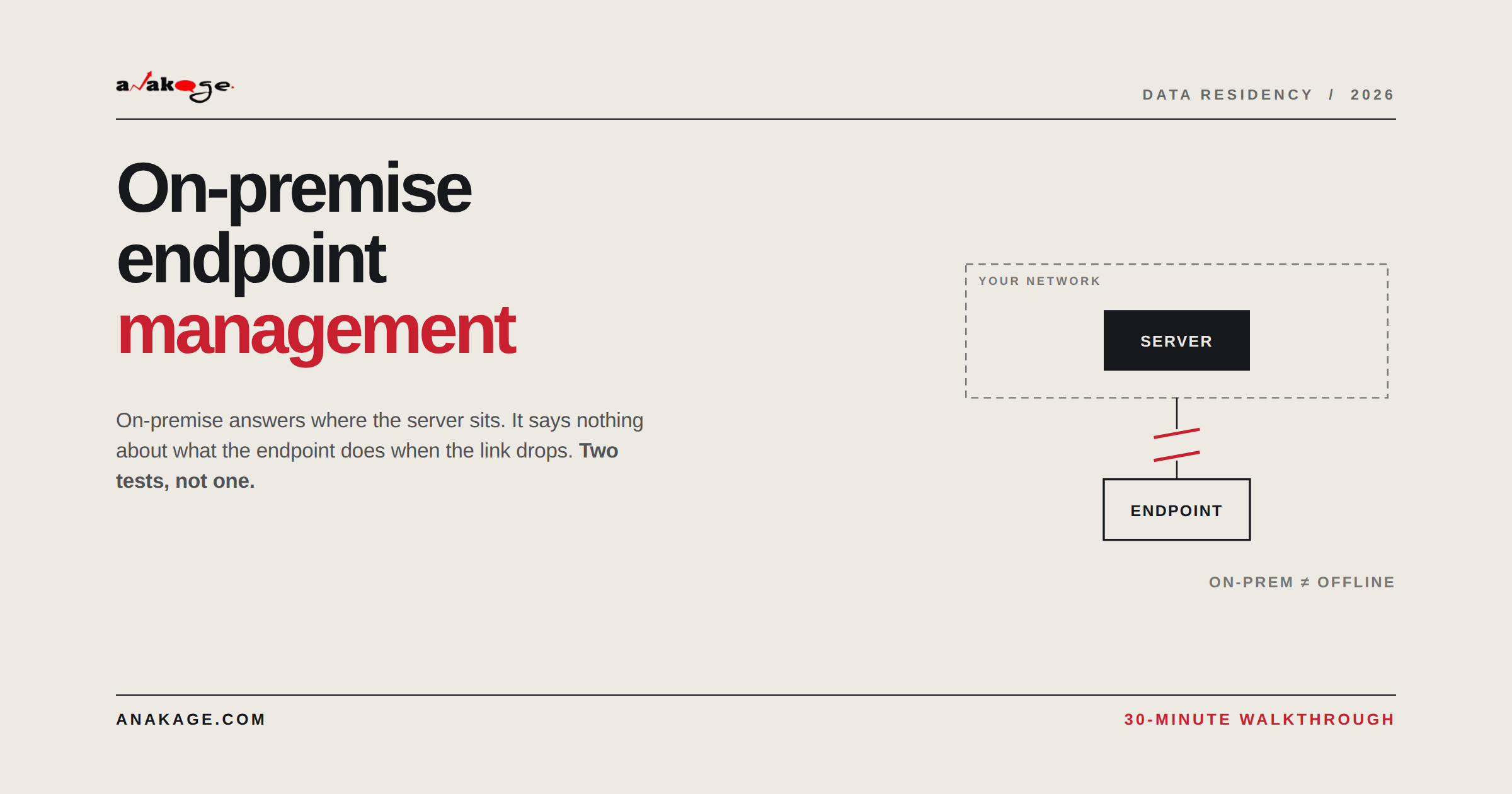
The first is where the server sits. On-premises means the management server runs in your datacentre and telemetry stays inside your network. That answers data residency.
The second is what happens when an endpoint disconnects. Your branch laptop drops off the VPN for a week. Does the agent keep detecting and fixing problems on its own, or does it wait for the network to come back?
Lakeside SysTrack shows how far apart those two answers can sit. It deploys on-premises, and reviewers note it works out cheaper than cloud DEX for that reason. (Source: PeerSpot, 2026) Its self-help portal is online-only though, so a disconnected user gets nothing. (Source: Anakage competitor analysis, July 2026)
The server stays in your building while the endpoint still needs a network to help anyone. If you bought on-prem to solve a branch connectivity problem, that is where the project stalls.
Who Offers What
| Tool | Deployment | Endpoint works offline | Notes |
|---|---|---|---|
| Anakage | On-premises | Yes, fully | Agent detects and remediates without connectivity |
| ManageEngine Endpoint Central | On-prem or cloud | Partial | Genuine on-prem editions, broad UEM |
| HCL BigFix | On-prem, hybrid or cloud | Partial | Relay architecture, ~100 OS variants |
| Tanium | On-prem or cloud | Partial | Real-time query at scale, security-led |
| Motadata ServiceOps | On-prem, private or public cloud | Partial | Service desk, assets and patch on one licence |
| N-able N-central | Cloud or self-hosted | Partial | Self-hosting is rare in modern RMM |
| Lakeside SysTrack | On-premises | No (portal is online only) | Deep telemetry, needs SQL Server underneath |
| Microsoft Intune | Cloud | Policy cache only | No on-premises option |
| NinjaOne | Cloud | No | |
| Action1 | Cloud | No | Free under 200 endpoints |
| Automox | Cloud-native | No | Needs connectivity by design |
| Atera | Cloud | No | |
| Ivanti Neurons for UEM | Cloud | No | |
| Nexthink | Cloud | No |
Deployment data from Motadata, July 2026, and vendor documentation. The offline column comes from the Anakage competitor analysis, which is vendor-published, so test it yourself. “Partial” means some functions continue offline and others do not. Confirm which ones matter to you.
What Actually Breaks When an Endpoint Disconnects
Run through this list against your own estate.
Patch deployment stops. The device misses the cycle and reports non-compliant when it reconnects, or reports nothing at all.
Self-service becomes unreachable, and this is the one that hurts. A user locked out of their account cannot open a web portal to reset the password, because the portal needs the login they do not have.
Detection pauses. Disk fills, antivirus stops, group policy drifts, and nobody knows until the machine comes back carrying all of it at once.
Compliance reporting goes stale. Your dashboard shows the last known state, which may be three weeks old. An auditor asking about a specific branch on a specific date will not accept that.
For a bank with 200 branches on thin links, or a manufacturer with plant floors behind a firewall, that covers most of the estate.
What On-Premises Actually Costs
On-premises changes where the money goes.
ManageEngine Endpoint Central on-premises starts around $795 a year for 50 endpoints, against roughly $1,045 for the cloud edition at the same size. (Source: Motadata, July 2026)
The licence is only part of the bill. SysTrack, for instance, needs SQL Server and Windows Server licences underneath it, plus the hosting. (Source: PeerSpot, 2026)
Then there is admin time, because you patch, back up and upgrade the management server yourself.
Against that, weigh what downtime costs. More than 90% of mid-size and large enterprises put one hour of downtime above $300,000. (Source: ITIC 2024 Hourly Cost of Downtime Report, cited by Motadata)
If your constraint is regulatory, cloud was never on the table, so the real comparison is on-prem against doing nothing.
Five Questions That Separate Real Answers From Datasheets
Vendors answer “yes, we support on-premises” far more readily than they answer these.
- Where is telemetry processed, as well as stored? Several vendors store data on-prem and process it in their cloud. Ask about processing specifically.
- Show me a remediation running on a disconnected endpoint. Ask them to unplug a laptop during the demo and fix something on it. This one ends most conversations faster than any other.
- What does the agent do during a two-week outage? Queue actions, act locally, or sleep? Get the answer in writing.
- Can a locked-out user reset their password with no network? If the reset path is a web portal, the answer is no, whatever the datasheet says.
- What infrastructure do I run underneath this, and who licenses it? SQL Server, Windows Server, hosting. Get the full stack costed before you compare it to a cloud quote.
When Cloud Is the Right Answer
Not every residency conversation is a real constraint.
If your endpoints are mostly laptops on home broadband and office wifi, and your organisation already runs Microsoft 365 or Google Workspace, the cloud tools are better products. They deploy faster and cost less to run, and nobody on your team is maintaining a management server.
Cloud-first tools like Intune, NinjaOne and Action1 are the default now, with regulated industries as the exception. (Source: Motadata, July 2026)
The failure mode is buying on-premises for a policy that does not actually exist, then carrying the infrastructure overhead for years. Confirm the requirement with your security and compliance teams in writing before it shapes your shortlist.
If Your Constraint Is Real
A few things make the shortlist manageable.
Write the constraint down precisely. “No customer data leaves India” is a different requirement from “no endpoint telemetry leaves our network,” and they eliminate different vendors.
Separate the two tests. On-premises deployment, and offline endpoint operation. Score every vendor on both.
Test offline during the pilot, while you can still walk away. Take ten machines off the network for a week and count what the tool detected and fixed while they were gone.
Anakage runs on-premises with agents that detect and remediate while fully disconnected, including self-service password reset for users with no network path. It fits a narrow set of requirements, and if yours are not on that list, the tools above are better choices.
FAQ
Q: Which endpoint management tools still run on-premises?
A: ManageEngine Endpoint Central, HCL BigFix, Tanium, Motadata ServiceOps and N-able N-central all offer on-premises or self-hosted deployment. Lakeside SysTrack is on-premises by design. Intune, NinjaOne, Action1, Atera, Automox and Ivanti Neurons are cloud-only.
Q: Is on-premise the same as working offline?
A: No, and conflating them causes real problems. On-premises means the management server sits in your datacentre. Offline operation means the endpoint agent keeps detecting and fixing issues with no network. A tool can do the first and still fail at the second.
Q: Can Intune run on-premises?
A: No. Intune is cloud-native with no on-premises option. It caches policy locally, so some enforcement survives a short disconnection, but management is cloud-based. Co-management with Configuration Manager is the usual route for teams needing on-prem capability alongside it.
Q: What happens to my endpoints when they lose connectivity?
A: It depends entirely on the tool. Patch deployment usually stops, self-service portals become unreachable, and detection pauses until reconnection. The case that hurts most is a locked-out user, who cannot open a web portal to reset the password they need to log in.
Q: Do on-premise endpoint tools cost more?
A: The licence is often cheaper. ManageEngine’s on-premises edition starts below its cloud edition at the same endpoint count. The real cost sits underneath, in SQL Server and Windows Server licensing, hosting, and the admin time to maintain the server.
Q: Which DEX tools support data residency?
A: Lakeside SysTrack deploys on-premises. Most of the DEX category, including Nexthink, is cloud-dependent. If residency is a hard requirement, the DEX field narrows considerably and you may need to look at endpoint management or automation tools instead.
Q: How do I verify a vendor’s offline claims?
A: Take ten machines off the network for a week during the pilot. Count what the tool detected and remediated while they were disconnected. Ask for a live demo on an unplugged laptop instead of accepting a datasheet claim.
Closing
On-premises and offline are different requirements, and a tool that satisfies one can leave you exposed on the other. Write both down before you shortlist.
If your endpoints genuinely go dark for days at a time, the Anakage team will tell you in 30 minutes whether your environment is a fit, including the cases where it is not https://anakage.com/contact-us.html