There is a question that increasingly comes up in modern enterprise IT environments:
“We already have an EDR. Why would we need another agent on the endpoint?”
It is a fair question.
Enterprise endpoints are already crowded with security, management, monitoring, and productivity tools. No IT leader wants another overlapping layer, another console, or another agent competing for resources.
But there is an important distinction that often gets lost in the conversation:
Security and endpoint operations may share the same device, but they are solving different problems.
That is where the relationship between EDR and Anakage becomes interesting.
The easiest way to understand it is to stop thinking of Anakage as another security gate.
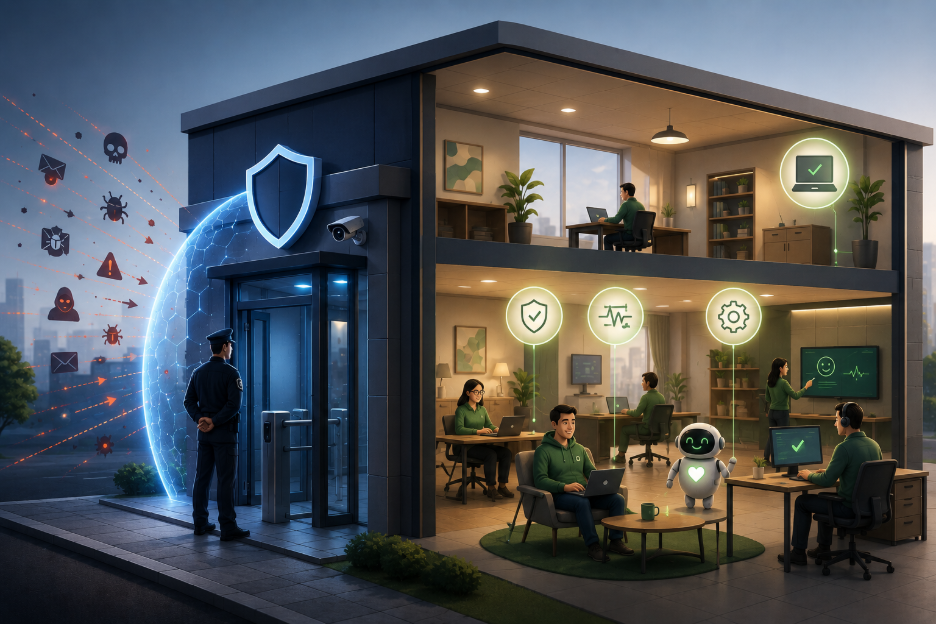
Think of it as the team working inside the building.
The endpoint is under pressure every second
The modern enterprise endpoint is no longer a quiet workplace asset. It is one of the most active points of interaction between employees, applications, identities, networks and external services.
Palo Alto Networks’ Unit 42 found that endpoints were involved in 72% of the incidents in its 2025 incident-response dataset. More strikingly, attackers operated across multiple fronts in 84% of incidents, showing that modern attacks rarely stay confined to a single security layer.
The scale of activity is also enormous.
In India’s 2025 cyber threat report, Seqrite reported more than 369 million security incidents across 8.44 million endpoints during its observation period—an average of roughly 702 incidents per minute, or about 11 per second. Importantly, these figures represent detected security incidents rather than 11 unique successful attacks every second.
That distinction matters.
Because the job of the enterprise security stack is not to make the endpoint perfectly quiet.
Its job is to make the endpoint defensible.
And this is exactly where EDR plays its role.
EDR is the door guard—and a very capable one
Modern Endpoint Detection and Response platforms continuously monitor endpoint activity, identify suspicious behavior, investigate threats and enable response actions. Microsoft describes EDR as a technology that monitors endpoint activity, detects suspicious behavior and helps security teams investigate and respond to threats in real time.
Modern EDR platforms can go much further than simply raising an alert.
They can use behavioral analytics, threat intelligence and automated response to detect malicious activity and, in some scenarios, isolate a compromised endpoint or contain an attack.
So imagine the endpoint as a building.
EDR is the sophisticated security system at the door.
It watches who is entering.
It identifies suspicious behavior.
It can stop a threat.
It can isolate a compromised device.
It can investigate what happened.
It can help security teams understand whether someone has crossed the line from normal activity into malicious activity.
That is an essential job.
But now consider what happens inside the building.
A printer stops working.
The VPN configuration is broken.
Disk space falls below a healthy threshold.
An application crashes repeatedly.
A required service stops.
A patch is missing.
A security control becomes inactive.
A user encounters a recurring issue and raises a ticket.
None of these problems necessarily represent a malicious actor.
But they can still bring the employee’s work to a halt.
And this is where another capability is required.
Not every endpoint problem is a security incident
This is the fundamental difference.
EDR asks:
“Is this endpoint exhibiting behavior that could indicate a threat?”
Endpoint operations asks:
“Is this endpoint healthy, compliant, usable and able to support the employee?”
Those questions can exist on the same machine at the same time.
They are not competing questions.
They are complementary ones.
In fact, enterprise endpoint environments increasingly need both.
An EDR platform provides security visibility and response.
An endpoint automation platform can provide operational visibility, remediation, self-healing, guided assistance, software automation, compliance actions and ITSM integration.
Anakage is built around this second problem.
Its platform combines endpoint telemetry, digital employee experience, proactive remediation, self-healing, automation, software deployment, ITSM integration and service delivery capabilities.
That means Anakage does not need to replace the security system.
It can work alongside it.
The overlooked space between “secure” and “working”
This is where the coexistence story becomes especially important.
An endpoint can be secure enough to pass a security check and still be a terrible employee experience.
Consider a few examples.
A laptop has its EDR agent running correctly, but the device is running critically low on disk space.
An EDR may correctly see nothing malicious happening.
The employee, meanwhile, cannot install an application, save a file or complete a software update.
Or consider an application that repeatedly crashes because of a configuration or dependency issue.
Again, there may be no security incident.
There is simply an employee who cannot work.
Or take compliance.
A security platform may identify that a control is inactive or that a configuration needs attention. The security team now knows that something requires remediation.
But someone still has to perform the operational action.
This is where endpoint automation can become the bridge between detection and action.
Anakage’s event-driven automation capabilities, for example, can use endpoint telemetry and configurable conditions to trigger targeted actions. A documented example is automatically initiating remediation when a threshold such as low disk space is reached; the platform can also trigger actions when security-relevant conditions such as antivirus inactivity are detected.
The key point is not that Anakage is “better security” than an EDR.
It isn’t trying to be.
The point is:
Once the security platform identifies a condition, the endpoint still needs to be managed.
That is where the two can complement each other.
Think of EDR as the guard. Think of Anakage as the response crew.
The best enterprise environments do not ask one system to do every job.
A sophisticated building has a security system.
It also has facilities management.
Security cameras do not repair a broken elevator.
Access-control systems do not refill the fire extinguisher.
A security alarm does not fix an air-conditioning failure.
They coexist because they operate at different layers of the same environment.
The same principle applies to the endpoint.
EDR
Protects the endpoint from threats.
It monitors behavior, identifies suspicious activity, investigates incidents and supports containment and response.
Anakage
Keeps the endpoint operational and the employee productive.
It can observe endpoint health and experience, proactively remediate common issues, automate endpoint actions, support self-service and integrate with ITSM workflows.
Together, the model becomes much more powerful:
EDR detects and protects.
Anakage observes, fixes and automates.
And the most important part: coexistence does not mean duplication
The concern about two agents is legitimate.
Enterprises need to know:
Will they interfere with each other?
Will both try to modify the same endpoint configuration?
Will one create noise for the other?
Will IT teams end up managing two disconnected systems?
This is where architecture and governance matter more than the mere presence of two agents.
Anakage’s own platform positioning explicitly supports keeping existing investments and using Anakage as an automation layer across an existing enterprise tool landscape rather than forcing a rip-and-replace approach. Its current platform also emphasizes integrations across ITSM, UEM and security tooling.
In other words, coexistence should not mean:
“Let’s install another tool and hope the two agents behave.”
It should mean:
“Let’s give each system a clearly defined job.”
The security platform owns threat detection and security response.
The endpoint automation layer owns operational remediation and employee-facing resolution.
The ITSM platform remains the system of record for incidents and requests.
And integration connects the three.
What does this look like in the real world?
Imagine an employee’s laptop suddenly develops a problem.
Scenario 1: A real security threat
EDR detects suspicious behavior.
The security platform investigates the activity and can take containment or remediation action according to the organization’s security policies.
This is EDR’s territory.
Anakage does not need to interfere.
Scenario 2: A routine endpoint problem
The laptop’s disk falls below a defined threshold.
There is no malicious activity.
Anakage detects the condition through endpoint telemetry and can trigger an approved cleanup or remediation workflow.
The employee gets back to work without turning a small issue into a service-desk interaction.
Scenario 3: A security-related operational condition
A security control becomes inactive.
The EDR or security stack can surface the condition.
Anakage can then participate in the operational remediation workflow—subject, of course, to the organization’s security policies and approvals.
The distinction is important:
EDR identifies the security condition.
Anakage can help execute the operational fix.
Scenario 4: The employee raises a ticket anyway
This is where the relationship becomes even more interesting.
Anakage has long supported ITSM-integrated endpoint automation, where a user-created ticket can be analyzed and a relevant endpoint solution can be triggered automatically rather than waiting for a service-desk engineer to manually intervene.
The ticket remains part of the service-management process.
But the endpoint action does not necessarily have to wait for a human.
The result is a different operating model:
Detect → Decide → Automate → Resolve → Record
rather than:
Detect → Ticket → Queue → Engineer → Remote session → Resolve
That distinction becomes significant at enterprise scale.
The real objective is not “more tools”
This is probably the most important point in the entire discussion.
The goal should never be to give IT another dashboard.
It should be to reduce the amount of work that humans have to perform manually.
Security teams should be able to focus on security.
Service-desk teams should be able to focus on issues that genuinely require human judgment.
Employees should not have to wait for an engineer to fix problems that automation can safely resolve.
And endpoint teams should have enough telemetry and control to move from reactive support to proactive operations.
This is also why the conversation about EDR and Anakage should not be framed as “EDR versus Anakage.”
It is a false choice.
The more useful question is:
“What happens after the endpoint tells us that something needs attention?”
Because an alert is not the same thing as a resolution.
A detection is not the same thing as remediation.
And a secure endpoint is not automatically a healthy endpoint.
The enterprise endpoint needs both defense and resilience
The modern endpoint has become too important to manage through a single lens.
It has to be:
Secure enough to resist threats.
Healthy enough to perform.
Compliant enough to meet policy.
Automated enough to recover.
Simple enough for employees to use.
EDR is a critical part of the first objective.
Anakage can help address the others.
And that is why coexistence makes sense.
Not because an enterprise needs more software.
But because different problems deserve different capabilities.
The security guard should remain focused on keeping threats out.
The team inside should keep the building functioning.
And when those two teams communicate well, the organization gets something more valuable than either one alone:
an endpoint that is not only protected—but continuously operational.
The Coexistence Series
The EDR conversation is only one example of a broader question enterprise IT leaders are asking:
“Where does Anakage fit when we already have a tool for that?”
That question deserves a better answer than “replace it.”
The more interesting answer is often:
“Keep what already works. Add automation where the operational gap remains.”
That opens the door to a wider coexistence series—looking at how Anakage can complement existing investments across security, endpoint management, ITSM, patching, employee experience and automation.
Because in a mature enterprise environment, the winning strategy is rarely about having one tool do everything.
It is about making the tools you already have work harder—together.
Sources: Microsoft Security on EDR capabilities and endpoint detection/response; Palo Alto Networks Unit 42 2025 Incident Response Report; Seqrite India Cyber Threat Report 2025; Anakage platform and endpoint automation documentation.