
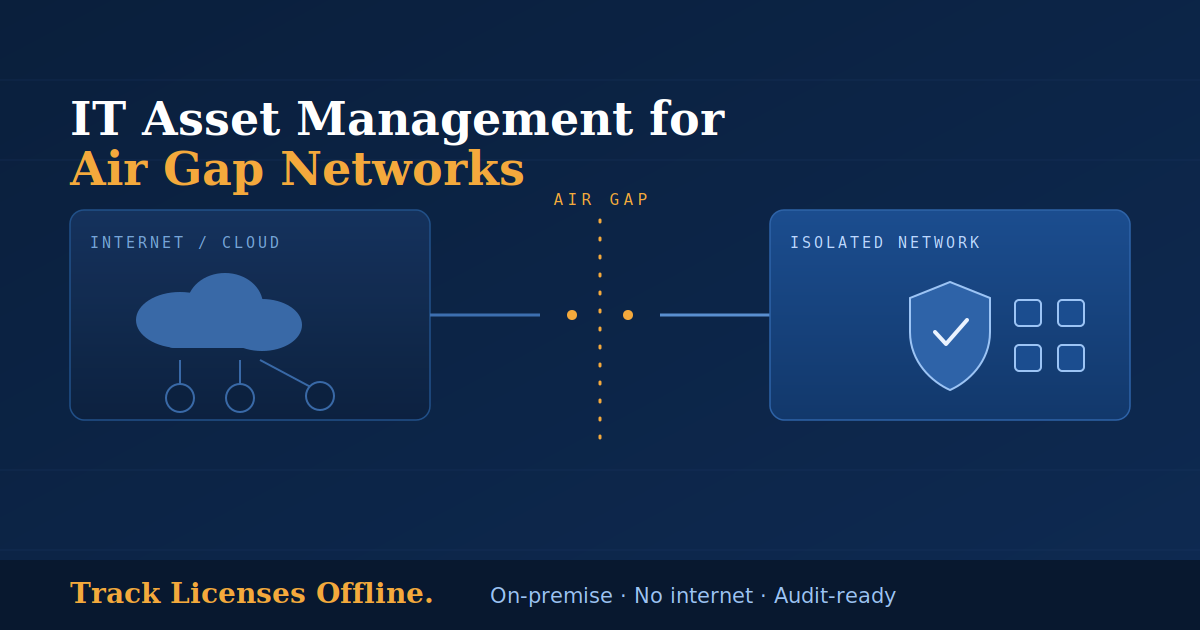
Tracking software on an air gap network needs IT asset management software that runs fully on-premise, with local discovery and no cloud dependency. Most standard asset management tools fail here because they assume internet access. Here is how to track licenses, build an offline inventory, and stay audit-ready without ever connecting to the internet.
This guide is for IT managers running isolated networks in banks, NBFCs, government bodies, and manufacturing firms. We will keep it practical, with real steps you can use this week.
What Is an Air Gap Network?
Air gap network — a network physically isolated from the internet and all external connections. Data moves in and out only through controlled removable media.
You find these in places where security matters most. Think trading floors, defence units, SCADA systems, and core banking servers.
The upside is a tiny attack surface. The downside is operational pain. Every update, scan, and report has to happen without the internet.
Why Standard IT Asset Management Software Fails Offline
Most asset management software assumes one thing: a live internet connection. On an air gap network, that assumption breaks everything.
Here is where common tools fall short:
- Cloud-only agents. Tools like Spiceworks run from the cloud. No internet means no discovery.
- License servers phone home. Many platforms validate licenses online. Offline, they simply stop working.
- Per-device pricing climbs fast. ManageEngine and SCCM bill per node, which gets expensive across many segments.
- Reports need a portal. Audit data sits in a cloud dashboard you cannot reach from inside the gap.
The result is a familiar mess. Teams fall back to spreadsheets, manual counts, and guesswork. That falls apart the moment an auditor walks in.
How to Track Software Licenses on an Offline Network
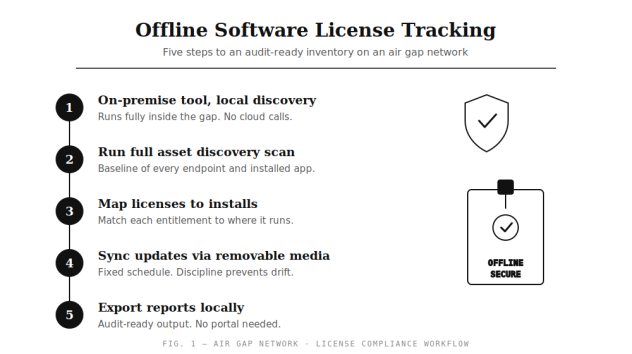
You can build a clean, audit-ready system without the internet. Follow these steps in order.
- Pick an on-premise tool with local discovery. It must scan and store data inside the air gap. No cloud calls.
- Run a full asset discovery scan. This builds your baseline inventory of every endpoint and installed application.
- Map licenses to installs. Match each paid license to where it actually runs. This is your compliance core.
- Set a manual sync routine. Use removable media to move update metadata in on a fixed schedule.
- Generate reports locally. Export audit-ready reports from inside the network, not from a cloud portal.
For networks under 500 endpoints, the first full discovery scan usually takes 2 to 4 hours. After that, incremental scans are much faster.
Software License Tracking and Inventory Management
Good software tracking is not just a count of what you own. It is proof of what you use, where, and under which license.
A solid offline inventory management software setup records three things. The asset, the installed software, and the matching license entitlement.
This is what turns a panic before audit season into a routine export.
Patching an Air Gap Network Without Internet
License tracking only works if your software stays current. Patching offline is its own challenge.
The standard Windows approach uses two WSUS servers. One online to download updates, one inside the gap to deploy them. You move the data across with removable media.
Microsoft documents this export-import method in detail. See their official guide on synchronizing updates with no internet connection.
The key is discipline. A missed sync cycle means out-of-date software, which is exactly what auditors flag.
Staying Audit-Ready for RBI and Compliance
For Indian banks and NBFCs, this is the real pressure. An RBI IS audit checks software license compliance and patch currency directly.
Auditors want to see clear evidence. Which licenses you hold, where they run, and whether your systems are patched.
You can read the official compliance context on the Reserve Bank of India site.
A tool that exports this data on demand saves days of manual work. Anakage is one option worth considering here. It is built for offline and air-gapped environments and produces audit-ready reports without internet access.
It is not the right fit for everyone. Small businesses and cloud-first teams have simpler, cheaper choices. But for compliance-heavy offline networks, it solves a specific problem well.
If your environment matches that, Anakage offers a free 30-minute demo at anakage.com/book-a-demo.
Choosing the Right Tool for Your Network
Not every IT asset management software belongs on an air gap network. Use this short checklist when you evaluate.
- Runs fully on-premise with no cloud dependency
- Performs local discovery inside the isolated segment
- Tracks licenses against actual installs
- Exports audit-ready reports locally
- Does not lock you into per-device pricing
If a tool fails the first two checks, it will not survive your environment.
FAQ
Q: What is the best IT asset management software for air gap networks?
A: The best fit is an on-premise tool with local discovery and no cloud dependency. Anakage is built for offline environments, while open-source options like OCS Inventory suit smaller setups. Match the tool to your compliance needs and network size.
Q: How do you track software licenses without internet?
A: Use on-premise asset management software that scans and stores data inside the network. It maps each license to its actual install. You then export compliance reports locally, with no cloud portal needed.
Q: Why do most asset management tools fail on offline networks?
A: Most tools assume a live internet connection for agents, license checks, and reporting. On an air gap network, those features stop working. You need a tool designed to run fully offline.
Q: How do you patch software on an air gap network?
A: The common method uses two WSUS servers, one online and one offline. You download updates online, then move them across with removable media. This keeps systems current without direct internet access.
Q: Can air gap networks pass an RBI IS audit?
A: Yes, with the right evidence. Auditors check license compliance and patch currency. An on-premise tool that exports audit-ready reports makes this straightforward.
Q: Is software tracking different from inventory management?
A: They overlap but differ. Inventory management lists your assets and installed software. Software tracking adds the license layer, proving each install is properly entitled.
Closing
Managing an air gap network is harder, but license tracking does not have to be. The right on-premise tool turns audit prep from a scramble into a simple export.
If you run a compliance-heavy offline network, Anakage has a demo worth a look. See it at anakage.com/book-a-demo.